CHECK TO HAVE LINKS OPEN NEW WINDOWS

Loading...


Vox populi: "In building bridges across communites, this site supports the efforts of Beliefnet.com and religioustolerance.org." Says Seeker of Truth (Reviews & Testimonials) @ xomreviews.com
The Blog Content Map is helpful organizing diverse material/content. Codakiz

 
  Browse By Label: Blog Content Map
Map
  Blogging    Books    Business--Religious aspects    Diversity   
    You are here
      Cyber Worship       Faith and the Media    Golden Rule   Holidays and holy days     Inner-Net    Interfaith Dialog
      
Knowledge Management    Libraries and Librarians    Multicultural
    People Prayers    Religious accommodation    Seekers     Spiritual Audit
      Symbols    Theology    Tolerance    Web analytics    Women

Showing posts with label Google. Show all posts

Saturday, July 03, 2010

Google is neither God nor Satan - Thought for the day

Picture (Some Questions Can't Be Answered by Google) courtesy: TameBay : eBay news blog

The Shallows: What the Internet Is Doing to Our Brains, Nicholas Carr (W. W. Norton & Company 2010; ISBN: 0393072223)

"Google is neither God nor Satan, and if there are shadows in the Googleplex they're no more than the delusions of grandeur. What's disturbing about the company's founders is not their boyish desire to create an amazingly cool machine that will be able to out think its creators, but the pinched conception of the human mind that gives rise to such a desire." (in Chapter Eight: The Church of Google, p. 176)

Review: The New York Times - Jonah Lehrer
While Carr tries to ground his argument in the details of modern neuroscience, his most powerful points have nothing do with our plastic cortex. Instead, The Shallows is most successful when Carr sticks to cultural criticism, as he documents the losses that accompany the arrival of new technologies.

Contents:
Prologue; The Watchdog and the Thief; One Hal and Me; Two The Vital Paths; a digression on what the brain thinks about when it thinks about itself; Three Tools of the Mind; Four The Deepening Page;a digression on lee de forest and his amazing audion; Five A Medium of the Most General Nature; Six The Very Image of a Book; Seven The Juggler's Brain; a degression on the buoyancy of IQ scores; Eight The Church of Google; Nine Search, Memeory; a digression on the writing of this book; Ten A Thing Like me; Epilogue Human Elements

Sunday, January 10, 2010

Google struggles with religious sensitivity

"Google results offend Christians, but if you search for “Islam is” Google will give you no search suggestions.
 
It wasn’t long ago experts claimed that we were entering the age of secularization. Instead the headlines of the new century have become dominated by religious fervor, not at least because of the rise of Muslim militants and 9/11." continue reading @ Pandia Search Engine News

See also:
  • Google favouring Islam? Matthew Moore, Expressbuzz, 11 Jan 2010
    Google has denied favouring Islam over other religions in its suggested searches, after allegations that phrases criticising the faith had been censored.
  • Google 'censors its website so anti-Islam  searches fail to appear   Daily Mail   Neil Millard


  • Google suggests Islam is nothing


  • "The metaphysics of search, The Register, 11th January 2010

    Google's search Suggest function treats Islam a bit differently from the other major religions of the world. It's willing to suggest "Christianity is bullshit" or "Judaism is false," but if you begin to ask what Islam is, it won't suggest a thing..."

  • Is Google Censoring Islam Suggestions? Wired News

  • Wednesday, December 16, 2009

    What is Your One Main Failure of the Year 2009 - Are You Ready for the Year 2010?

    What will you say about yourself in 2009? ...
    Lost battle? broken hearted? Cursed? Failed? ...
    Are you ready for 2010? Take this as a moment of reflection and resolution for the year 2010
    Note: At Blog Catalog you will find many responses: click here

    Similar themes:
    See also:
  • CTV News Announces the Top 10 Canadian News Stories of 2009
  • A year of nasty surprises, By Martin Knelman, Toronto Star, Wed Dec 23 2009
  • The Biggest Failure of the Year, By Morgan Housel, October 12, 2009 [don't miss this: Comments from our Foolish Readers]
  • Hepburn: GTA's top 10 winners and losers of the year, Toronto Star Dec 17 2009
  • Year Of Tumult: 2009 Marked By Failure, Scandal, Debt And A Sputtering Recovery
  • 2009: A Failure
  • Year in Review 2009: TV's Biggest Disappointments
    Despite all our gleeful griping, we honestly want all of our favorite shows to be good forever, and for new shows that look promising to deliver. But still, we can't ignore the fact that every season we still get disappointed by shows that should really know better. Here are all the storylines, characters, entire series, cancellations, finales, moments, and screw-ups that left us crying into our DVRs this year. — Television Without PityThursday, December, 17, 2009, 12:17 AM

  • for more Google, here and here

  • Sunday, March 01, 2009

    Googlization Revisited: faith-based Updates


    See on the same shelf:


    Tuesday, March 04, 2008

    Economics and Spirituality: The Nexus

    Sunday, February 03, 2008

    Introduction to Judaica Librarianship @ video.google.ca

    Introduction to Judaica Librarianship Part 1, 1 hr 6 min 15 sec - 28-Aug-07 ,
    Introduction to Judaica Librarianship Part 2 51 min 6 sec - 28-Aug-07 ,
    source : http://www.jewishlibraries.org/

    Sherry Wasserman hosts the 2006 Association of Jewish Libraries Freshman Seminar designed for those new to Jewish libraries, especially

    Wednesday, November 07, 2007

    Even Athiests pray … figures don't lie!

    CORRECTED: Even Atheists pray … figures don't lie!

    November 4th, 2007 by Nancy Reyes
    Surveys show that 52% of Americans pray every day, 57% of Catholics pray every day, 41% of those who aren’t sure of life after death pray every day, and 15% of people who aren’t sure there is a God pray every day.***

    He said, with a grin, that people pray “to whom it may concern” or […] Read the rest of this entry »
    Posted by Nancy Reyes in All News, Society and Culture, US News, Religious News No Comments » 73 Views


    See also on the same shelf:
  • The scandal of particular prayers, Posted by dpulliam
  • Comparing Muslim Beliefs and Practices
  • PEW Surveys
  • Catch Hell: Newsweek/Beliefnet poll results -- Beliefnet.com
    A new poll points to growing importance of 'spirituality'; most believe people of other faiths can go to heaven
  • Finding Our Own Path, By Jerry Adler, Newsweek
    Americans favor individual spirituality and personal empowerment--which has influenced even traditional, institutional religion. To read the entire article, click here. (C) 2005 Newsweek, Inc.
  • Spirituality in Action: The Road Ahead
  • If you don’t like the word God, substitute Nature, All Being, or Reality. If you don’t like the word “Word,” substitute something like “impulse.”
  • Google it
  • Spirituality: The Age of Aquarium:
  • Schools of Fish and Thought
    The theists prayed and said “Amen,” while atheists said “Ahem . . .”
    “There’s no such thing, you silly goofs; you haven’t any proof.”
    Panentheists sought elbow room, they tried to wriggle in.
    That en’s a tricky syllable; it splices God’s hair thin. continue reading @ Faithcommons

    ***Survey sources are listed below, courtesy Nancy Reyes:

  • The talk was given at a local university and reviewed in the local Catholic paper in western Massachusetts, where I am visiting my brother. They don't have a website, but the announcement is here.
  • But this NYTimes article refers to the same data:
  • This article on his website examines the belief in life after death and notes that not all atheists are "hard core" atheists. http://www.agreeley.com/articles/hardcore.html
  • The NORC website is here.
  • Presumably the research is published in journals...several of his surveys can be found at JSTOR, but since I don't have access, I can't read the hard sociological data.
  • Wednesday, October 31, 2007

    Sunday, June 17, 2007

    Little Mosque on the Prairie

    "When a young lawyer from Toronto decides to become an Imam, he decides to move west to the prairies to pursue his true calling. As the new spiritual leader arrives in his new home, the Muslim community butts heads with locals. Watch the series"


    See also
  • Watch all episodes at Google video, or @ YouTube.com
  • NBC honcho shows interest in Little Mosque The Globe and Mail,
    GUY DIXON, June 14, 2007
  • Brazilian TV and Muslimness in Kyrgystan / Julie McBrien ISIM Review 19, Spring 2007
  • Saturday, May 05, 2007

    The Souls of Superheroes - Faithwise Review of the Week

    Spider-Man 3 trailer:


    7 Minutes Of EXCLUSIVE Spider-Man 3 Scenes!!!


    "Spider-Man 3" is more than an action movie--it's full of religious and moral themes. How much do you know about Spider-Man's spirituality and the faith of other superheroes? continue reading @ Beliefnet.com


    This just in: BrainPOP Adds “Arts & Music” `Spider-Man 3' nets record $59M in 1 day, By DAVID GERMAIN, AP Movie Writer, Sat May 5, 2007

    Movie-goers pass a poster featuring Spiderman 3 at Jordan's IMAX theater in Reading, Mass., Friday May 4, 2007.  Tickets for Spiderman 3, which made its debut Friday, were completely sold out until Monday at the theater. (AP Photo/Charles Krupa)

  • Islam goes digital
    Cairo - Egyptian residents, already summoned to prayers five times a day by a chorus of scratchy loudspeakers, are now clamouring for a new line of portable electronic devices to show their devotion to Islam. Digital Korans, automatic prayer reciters and headphones dispensing religious advice are all part of the growing wave of outward religiosity that is increasingly defining daily life in Egypt. continue reading

  • Egypt's faithful crave new Islamic gadgets
  • Digital Qur'an finds home in Cairo
  • Fatwa: Women and Men Touching in Pro-Wrestling
  • Too hot for prime time? Once again a pulled TV ad – this time for Chanel lipstick – has generated controversy over acceptable standards
    KEITH MCARTHUR, From Thursday's Globe and Mail, 19/04/07
    The agency that screens ads for Canada's private broadcasters is at the centre of controversy again over efforts to protect the public from advertising deemed too hot for TV. This time the controversy is over an ad for Chanel lipstick in which Swiss model and actress Julie Ordon — clad only in a sheet — rolls seductively in bed and asks her clothed male companion if he loves her lips. “There's absolute nudity in the spot.
  • Gere-Shetty kiss sparks Indian lawsuits Last Updated: Wednesday, April 18, 2007 9:27 AM ET, The Associated Press


  • See also book discussion @ Google Video:
  • Cyber worship in Multifaith perspective - part1
  • Cyber worship in Multifaith perspective - part2
  • Cyber worship in Multifaith perspective - part3
  • Cyber worship in Multifaith perspective - part4

    Related posts from my blog:
  • So much of visual literary genre, so little time to categorize it
  • Sunday, March 04, 2007

    Forgive Me When I Whine, by Red Foley


  • Album: MY KEEPSAKE ALBUM
  • Text: The World Is Mine - Lord Forgive Me When I Whine
  • In Images @ Google Images
  • Send this poem via Greeting card @ Home with God
  • Text again (Indonesian adaptation): Ya Allah
  • Nasheed from Zain Bikha's Album 'Mountains of Mecca' Presented By Yamustafa.com, audio
  • Graphics (Christian version with background music from the song, "Tell Me That Story"):
  • Voice (Arab adaptation):
    Ahmed Bukhatir with Arabic Music and Islamic prayer:


    See also on Forgiveness from a co-blogger:

  • To err is human; to forgive, infrequent.....

    Bottomline: The image here, courtesy Bro Junaid, facilitated, my 2 cents worth, i.e., creating this blog post.
  • Monday, November 27, 2006

    Is There A Biblical Case For Voluntary Human Shields? - Faithwise Review of the Week


  • Is There A Biblical Case For Voluntary Human Shields? by WorldNews.com Correspondent Beverly Darling, Mon 27 Nov 2006
    Extract: Perhaps the greatest example of a voluntary human shield was Jesus and his revolutionary act of civilly disobeying the violent political and religious structures of the Roman Empire, and nonviolently attacking Rome’s executive powers by being executed (no pun intended) on the cross. In this act, he unmasked the aggressive and hateful ideologies that were common and utilized by the current authorities of the religious and state powers: redemptive violence and salvation through war. Unfortunately, they are still used today.
  • Clergy as Wounded Symbol, by Rabbi Susan Grossman, Virtual Talmud @ Beliefnet.com
    I agree wholeheartedly with Rabbi Waxman that clergy, of any faith, must be careful to see themselves, and allow themselves to be seen, as real human beings with human weaknesses and flaws. As Henri Nouwen so eloquently writes in his book, "The Wounded Healer," this ability to identify others’ suffering with the suffering in our own hearts, rather than maintain a role of aloofness, is a prerequisite for true ministering to the needy.
  • Religious Relic Crusader Battles Online Auction Giant @ Beliefnet.com
    Hardly an hour goes by without Thomas Serafin or one of his cyber-sleuths checking what eBay has to offer.
  • Circle healing: Strength of spirit, Toronto Star Nov. 26, 2006, MARIE WADDEN, ATKINSON FELLOW
    Extract: Circles are sacred shapes for the Anishnawbe people. In Hollow Water, circles of people are used to heal the scars of sexual abuse, which once threatened to engulf the community of 950. Their solution to this most heinous crime has been both successful and scorned: Embrace the abuser. In their world of justice, jails are a last resort.
  • Israeli Supreme Court Approves Overseas Gay Marriages, By Rachel Pomerance
    Religion News Service,
  • Clash with Hasidim easily resolvable, Multiculturalism accommodates all within the rule of law, says Haroon Siddiqui, Toronto Star Nov. 19, 2006
  • Fans claim God behind South Africa’s early batting collapse Monday November 27 2006
  • Saddam's Palakkad link, [in Kerala, South India] T S SREENIVASA RAGHAVAN, [ 26 Nov, 2006 0250hrs ISTTIMES NEWS NETWORK ]
    I’m praying for his welfare. Daily, I do archana in his name at the Shiva temple here. I’m certain he will come out unscathed,” Nair says, throwing his hands towards the heavens. [see also other stories about this store @ Google]
  • India sees God as creator, not controller, newindpress.com Sunday, 26 November , 2006, 21:48
  • good religion, bad religion @ Faith Commons
  • The Great Story, Submitted by Richard Blumberg, @ Faith Commons
    “[It] is a way of telling the history of everyone and everything that honors and embraces all religious traditions and creation stories.
  • Controversy dogs Britain's first state-funded Hindu school
  • Christians dig deep for graveyard plot
    India's Christians are running out of space to bury their dead, leading some to pay small fortunes to book their final resting place in a relative's grave.

  • Friday, November 17, 2006

    New Media and Religious Information Seekers

  • Too idle to read the Bible? It's in a blog
    London: If pious Muslims follow the Koran, might Christians and Jews benefit from a closer read of their scriptures too? Can Biblical verses help make them better people, better parents, or even get along better with their in-laws?

    People interested by such questions who haven't got much beyond the Adam and Eve story can join a man reading the Bible at http://www.slate.com, an online daily magazine.

    In 'Blogging the Bible', a vaguely religious man plods gamely through scripture, asking down-to-earth or occasionally irreverent questions, and getting thousands of emails in response. continue reading

  • SMS from Saudi Arabia promoting conversion to Islam, 15 November, 2006,
    Dialling “Call Me to Islam” is an initiative for those who want to know more about the Islamic faith, in nine languages
    Jeddah (AsiaNews) – “Call Me to Islam” is an initiative launched in Saudi Arabia by dawah activists to convert non Muslims to Islam via short message service (SMS) or receive information about Islam, Saudi daily Arab News reported.

    Dawah, which literally means ‘summons’, refers to Muslim responsibility to invite others to Islam. Now some activists have decided to go a step further. Anyone interested in learning about Islam can send an SMS to +966-55988899 and leave their names, nationality, language, religion, job and mobile number.

    The ‘spread Islam via SMS’ idea is the brainchild of Muhammad Al-Eiban, from the al-Badia Office for Foreign Communities, which operates under the supervision of the Ministry of Islamic Affairs. continue reading

  • National conference on the media and a multi faith society. 31 March 2004 London
  • International Conference on Media, Religion & Culture, 2006

    See also:
  • When Religion Meets New Media
  • Google: new-media "Religious Information"
  • Google: New-Media Religion

    See my previous post:
  • Overseas Indians turn to Web for festival prayers
  • My book CYBER WORSHIP IN MULTIFAITH PERSPECTIVE
  • Save the Time of the Godly: Information Mediators Role in Promoting Spiritual & Religious Accommodation

    Technocrati Tags:
    Multimedia.
    Digital media.
    New Media
    Cyber media
  • Wednesday, October 18, 2006

    Values and beliefs - rant of the day


    "Religious values motivate love, compassion, humility, justice and liberty for all people;
    religious beliefs and practices motivate hatred, cruelty, division, arrogance, injustice and oppression of others."


    Reverend Kenneth Carder, United Methodist Bishop, State of Mississippi
    Currently director of Duke University Divinity School’s Center of Excellence in Ministry


    For more Google

    Wednesday, July 26, 2006

    Rant of the day - Magic, Technology...


    Any sufficiently advanced technology is indistinguishable from magic
    - ARTHUR C. CLARKE [ source: CIOL - CyberTimes News Daily ]


    Google for magic and IT


    see also: my other blog on quotable quotes: Library & Information Science Quotations


    And, my review: Harold Billings Magic and Hypersystems: Constructing the Information-Sharing Library American Library Association, 2002.
    Information Resources Management Journal, 18(3), 88-91, July-September 2005

    Friday, June 30, 2006

    Secularism, Laicism, Diversity, Pluralism: What's In A Name?

    This is a running post: Updated 16 Nov, 2006


    Tolerance and Diversity in Islam
    11/16/2006 - By: Asma Afsaruddin, IslamiCity
    Long before the first ten amendments to the United States Constitution were formulated, medieval Muslim jurists developed what may be called an Islamic bill of rights ... continue reading Audio

    "What's in a name? That which we call a rose
    By any other word would smell as sweet."
    --From Romeo and Juliet (II, ii, 1-2) [source. See more on Allah Oath, Google]


    Any searcher must be clear about two things. First, what to search (for e.g., what keywords or terms); and second, where to search (such as, databases, library catalog, books, encyclopedias, or the Web's search engines) [If you are wondering where does this twain come from, let me make it clear. This is a part of systematic approach to information seeking, and information literacy considers this as an important strategy. See a guide to literature searching that illustrates this approach.]

    Incidentally, what to search doesn't mostly apply in case we are searching the free text (for instance, a database, or Web-based search engine). Google as a search engine, for instance, promotes free text search (rather than browse thro' Web directories; use a controlled vocabulary, thesaurus, subject headings for a uniformity in search terms, etc.).

    Interestingly, performing a free text search is possible by using all the keywords we may imagine. And, we may sometimes remember to include an alternative spelling, plurals, synonyms, homonyms, etc. Obviously, with such a powerful searchable tool, Google is facilitating a drastic change in our behavior about the way we seek and / or search information on the Web.

    Whereas, library catalogs and databases tend to continue to facilitate search by a term or recognized subject heading (not to say that free text or keyword search is missing; they do include this as well).

    But, the mian question relevant here is: Where are the uniform terms? In other words, is there any thing as a conceptually clear, systematic controlled vocabulary, that can be used for search of terms that are related, but used with different shades, used in different contexts, etc.? -- as in the case with terms such as, Secularism, Laicism, Diversity, Pluralism... is there any authority list? [If you are new, read more on Social Tagging for Library Science or on authority list discussion at LibraryThing, amidst the influence of clouds, free floating tags, etc. Click here]

    For this type of difference in terms, let's check the Library of Congress catalog:


    This much about the controlled vocabulary. I have a plan to analyze this variation and differences in providing a user-friendly controlled vocabulary. In the meanwhile, have a look at my Taxonomy of Faiths: A semantic journey.

    In the following are some samples of Web-based resources. This is not exhaustive, but gives a semblance of what are the real problematic areas for an indexer, bibliographer, etc.


    Allah oath

    Dismissing a PIL seeking that 11 MLAs who had taken oath in Allah’s name be disqualified, the court said if such oath is prevented, it would defeat the secular character of the nation [source: The Telegraph July 22, 2006]


    Web resources:
  • Time ripe for Islamic awakening, Dr M Iqtedar Husain Farooqi, HindustanTimes.com, July 21, 2006
  • SecularIndia.com
  • Islam and Laicism. Knowing Islam Abbés Jirari. 2003
  • LAICITY AND RELIGIOUS DIVERSITY. THE QUEBEC’S APPROACH - Report to the Minister of Citizen Relations and Immigration Conseil des relations interculturelles, Montréal (Québec). 2005 Article
  • Trying to Create an "Italian" Islam. Rigid Laicism Has Been Rejected Nikos Tzermias. Published: 27.12.2004 - Last modified: 11.01.2005
  • Islamic Concepts on Cultural Coexistence. Theory and Practice al-Khoei , Sayyed Abdol Majid. Centre for World Dialogue al-Khoei Foundation, London. London 1997 Article
  • Teaching Tolerance: Pioneering Anti-Bias Education
  • MULTIFAITH AND MULTICULTURAL MEDIATION SERVICE, The Global Green University, School of Nonviolence
  • Sandwell Libraries and Information Service Website. Multicultural Multifaith Resource Collection

    Diversity
  • Multicultural Library and Information Services Education
  • Faculty Diversity Web at UCLA
  • Diversity Web: An Interactive Resource Hub for Higher Education
  • Religious Identity and Intellectual Development: Forging Powerful Learning Communities, Victor Kazanjian, [Diversity in Higher Education: Why Corporate America Cares]

    My other similar post:
  • Searching Revisited: Horizontal, Vertical, Diagonal, etc.
  • Searching Is Polarized; Will The Five Laws Get a New Revised Version: Every Search Engine Its Searcher
  • Tuesday, June 06, 2006

    Vertical and tacit: Multifaith and Knowledge Management in Perspective

    ...knowledge resides in people: not in machines or documents. [continue reading, The duality of knowledge]

    This is my first experience to express the application of the field of Knowledge Management (KM) outside the business and coporate world. My inspiration for this comes from my own Webliography. This Webliography contains many resources and valuable documents. However, today I decided to go deeper into the domains that are less traveled by many KMs.

    Here, I would like to go with the terms vertical and tacit knowledge. My aim is to find a connection between, two facets, viz., a) the tacit knowledge and its use by Knowledge Management (KM) profession; and b), how deep is this penetration of KM in non-business circles, or precisely in everyday life. And in doing so I will focus on whatever relates to the individual with in the spiritual, religious and philosophical disciplines.

    The bottom line here is to find how a profession can aid in private and personal spaces. I don't need to say too much in this regard. This is well stated by Nancy White. And I quote:

    Recently on the KM4Dev (Knowledge Management for Development) list there has been a very interesting discussion on the impacts of major disasters such as epidemics, floods, wars, etc. on the knowledge base of a community or profession. What happens when HIV takes out a significant portion of a community's teachers, or engineers? What happens when the knowledge of local crops is lost during war, famine or natural disaster? What happens when a huge portion of a community's population does not return after a hurricane, depleting the rich knowledge of local history, culture and customs? These are huge issues.

    Terminology:
    What is tacit knowledge?
    By definition, tacit knowledge is not easily shared. One of Polanyi's famous aphorisms is: "We know more than we can tell. Tacit knowledge consists often of habits and culture that we do not recognize in ourselves...
    Tacit knowledge is embedded in group and organizational relationships, core values, assumptions and beliefs. It is hard to identify, locate, quantify, map or value. [source]

    Netizens, generally, use the term horizontal to imply it as the surface, or more probably to do flat thinking. Whereas, vertical, for the same virtual context, is going in the deep Web, i.e., going vertically by industry or subject categories [see: VerticalPortals.com].

    Vertical in Religious Connotation:
    However, from the faith perspective, there is also a religious analogy to explain the term: vertical. Most religions and spiritualities use this term to portray the connections that matter in the process. And, let me clarify:
    When Saint Thomas Church was celebrating its 175th anniversary as a parish in 1998, Bishop Grein spoke at our banquet about what he appreciated in Saint Thomas’s mission in midtown New York. He said, “It has something to do with vertical religion. And by that I mean those expressions and acts of our religion that draw us upward. Jacob’s experience at Bethel would be a good example of vertical religion, that ladder connecting heaven and earth, angels ascending and descending. There he encounters God.” [Religion: Vertical and Horizontal source]

    For Judaism, like most of Western culture, the controlling religious metaphor is vertical: religion is a matter of up and down. [An Introduction to Kabballah, source] or Google for more

    For a faithful, then, horizontal may refer to communitas, or a network of communities -- sharing works, words, messages, sermons, etc. In this context, Knowldege Managment (KM) is talking about the tangible, by and large.

    Obviously, vertical refers to the top to down (coming from the divine to the soul) or vice-versa. In this context from the knowledge management point of view, it is more so about the tacit, as a dominating source.

    One may argue and this possibility does exist. In fact, tacit may also be in horizontal communications and dialogue. For instance, inter-religious or intra-religious dialogue generates such knowledge. This possibility and overlap, is not ruled out. See for instance a citation in this context.
    It is an emerging process that has tremendous potential for transforming the way that people communicate and share tacit knowledge in everyday conversation. [source]

    Spiritual Healing:
    Spritual healing for and by people, the most wanted tool today, is related, by and large, to this tacit knowledge.

    As far as the tacit knowledge is concerned, there is a general understanding that theology can't be quantified [See: Russell Stannard, Experimenting with the Divine, Science and Theology News, May 2006].

    But, I think, there is no such constraint in measuring the qualititative aspects. In this is the room for discussion and research.

    Then, how or what matters in spiritual healing can be surmized in the following:
  • capturing this tacit knowledge
  • storing this tacit knowledge
  • sharing this tacit knowlege

    For instance, many faith communities have oral traditions and practices. The first step would be to capture this knowledge-base.

    One would also have a look at the following golden rules for tacit knowledge:

    1)suspend assumptions and certainties
    2) observe the observer
    3) listen to your listening
    4) slow down the inquiry
    5) be aware of thought
    6) befriend polarization
    For instructions about this best practice lesson go to: Dialogue, by Bill Isaacs, at siliconyogi.com

    More on this, as I find during my search, or based on the responses that I get from you all.
    ----------
    Vertical & Tacit:
  • Tacit Knowledge” versus “Explicit Knowledge” Approaches to Knowledge Management Practice by Ron Sanchez,
  • Cecil Hook, “Vertical and Horizontal Worship and Service To God,”
  • “Vertical religion--that which connects with God explicitly through prayer and repentance… horizontal religion—connecting people through common suffering and celebrating…” details;
  • “vertical aspiration of faith and spirit and the horizontal service of people's needs,” details
  • Rev. Barbara Kenley, First Presbyterian Church, Richmond, Indiana. “Sermon
  • Main Research Theme: Investigation and Construction of Memory in Everyday Life, Murakami Harumi

    Knowledge Management Domains, Tacit, and intangibles:
  • tacit vs. explicit theories: the impact on our thinking and 'theorizing,' Mentor Cana at November 18, 2004
  • Knowledge Management + Exoteric-Esoteric Duality

  • Walter Van Herck, The Role of Tacit Knowledge in Religion
  • Tacit Knowledge, Encyclopedia of Science and Religion.
  • Jerry H. Gill (Eckerd College, USA), Tacit knowing and religious belief, article in pdf [requires subscription], International Journal for the Philosophy of Religion. 6 (Summer), pp. 73-88
  • Victoria Ward and Clive Holtham, The Role of Private & Public Spaces in Knowledge Management
  • Nancy White comments on: Olaf's Notebook: What is the relation between KM and inner reform?
  • Higher level KM involves more of tacit knowledge management. article in pdf, requires subscription
  • David J. Owen, and and Min-Lin E. Fang, Information-seeking behavior in complementary and alternative medicine (CAM): an online survey of faculty at a health sciences campus, J Med Libr Assoc. 2003 July; 91(3): 311–321. full text of the article
  • “Faith of the Future: Updating Religious Paradigms for the Infotech Age” by Don C. Davis The Futurist, September-October 2005. 4 Pages. Article.
    Religious leaders now have a major opportunity to accept the new knowledge and capabilities created by science and technology. The author believes that this acceptance will help guide individuals to a global consciousness and a better understanding of their responsibilities for each other and the future of the world. see Fulltext
  • Chester, G. & Neelameghan, A. (2006). "Information Professional: Knowledge and Skills Development for Serving Marginalized and Rural Communities." Webology, 3(3), Article 29. Available at: http://www.webology.ir/2006/v3n3/a29.html
    Keywords: Rural community; Marginalized community; Information needs study; Information professional; Education and training; Curriculum design; Knowledge and skills; Communication skills; Community knowledge management; Outreach services
  • Real-Life Knowledge Management: Lessons from the Field, Editors: Abdul Samad (Sami) Kazi & Patricia Wolf
    "Through the eighteen case studies presented in this book, we learn about practical experiences in consultancies, financial institutions, fire fighting, global project management groups, public administrations, research and development organisations, small and medium enterprises, sports centres, the aerospace sector, the automotive industry, the construction industry, the IT sector, the maritime industry, the mould and die making industry, the nuclear industry, the oil and gas industry, and the water management sector. The case studies draw from a pool of experience spanning Austria, Belgium, Brazil, Finland, Germany, India, Israel, Italy, Norway, South Africa, the Netherlands, and the United Kingdom."
    Review: It’s not often that you get something for nothing but in this case you really can! ‘Real Life Knowledge Management – Lessons from the Field’ is a collection of 18 knowledge management case studies from across Europe and the Middle East... There are some really interesting case studies and the book is beautifully illustrated by Arye and Ron Dvir. Enjoy! Continue reading this review @ A Compound of Alchymie
  • Understanding knowledge management and information management: the need for an empirical perspective, by France Bouthillier and Kathleen Shearer, Information Research, Vol. 8 No. 1, October 2002
  • KM, IM, DM - Survival of the Fittest
  • Friday, June 02, 2006

    Knowledge Management Applications in Multifaith & / or Multicultural Transactions Revisited

    Whats making news today:
  • New Technology Probes Ancient Manuscript, By NICHOLAS PAPHITIS and Costas Kantouris, Thu Jun 1, 2006
  • Greek researcher Apostolos Pierris describes a new effort to read a burnt 2,400-year-old papyrus scroll CNN
    A collection of charred scraps kept in a Greek museum's storerooms are all that remains of what archaeologists say is Europe's oldest surviving book which may hold a key to understanding early monotheistic beliefs. More than four decades after the Derveni papyrus was found in a 2,400-year-old nobleman's grave in northern Greece, researchers said Thursday they are close to uncovering new text through high-tech digital analysis from the blackened fragments left after the manuscript was burnt on its owner's funeral pyre...

    Now, archaeologist Polyxeni Veleni believes U.S. imaging and scanning techniques used to decipher the Judas Gospel which portrays Judas not as a sinister betrayer but as Jesus' confidant will considerably expand and clarify that text. [ Continue reading] See Google News and other Blogs on this news story

    Faithwise Related Stories:
  • The Internet and Knowledge Management for the Bahá’í Faith
  • United Christian Faith Ministries - Knowledge Management and the Smarter Lawyer
    Related Resources:
  • Developing and evaluating a document visualization system for information management
  • Building a community memory : Capturing knowledge creation processes in online environments. "Working through the beaded curtain" Details
  • Developing and evaluating a document visualization system for information management Details


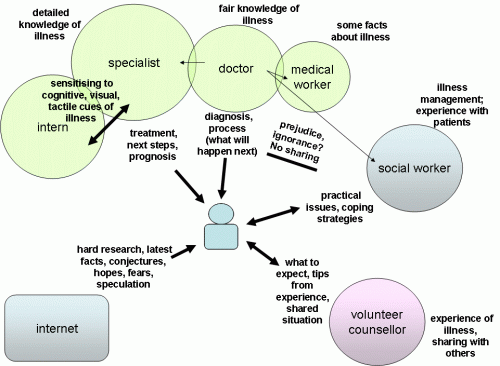
  • The above diagram offers interesting visualization for sharing knowledge, and is worth being considered for adapting in the Multifaith & Multicultural environments.


    Community Wise Resources:

  • Knowledge-Based Community Development A Path to Success
    What exactly is knowledge-based community development? ... Should you be thinking about going the way of knowledge-based community development? ...
  • Sharing Knowledge for Community Development and Transformation: A Handbook, by Dr. Kingo J. Mchombu. Originally published in October 2002 by Oxfam Canada, this 162-page handbook has been updated and is now in its second edition (2004). [Free publication] Contents include:
    Local Content: Internal Information and Knowledge Sources . . . . . .
    Indigenous Knowledge . . . . . . . . . . . . . . . . . . . . . . . .
    Traditional Objects and Items like Photos . . . . . . . . . . . . . . .
    Other Locally Created Information . . . . . . . . . . . . . . . . . .
    External Information and Knowledge Content

    See: previous item in this blog:
    Knowledge Management Applications in Multifaith & / or Multicultural Transactions
  • Thursday, June 01, 2006

    Multifaith Calendars - Visualize the Festivals, Feasts, Fasts, Festoons, etc

    Be Informed, Then Celebrate!
    Did you know that your employer has to accommodate your religious rights to celebrate whatever you wish to? Read:
    The Employer’s Duty to Provide Religious Accommodation. By P.A. Neena Gupta at Gowling Lafleur Henderson LLP for HRinfodesk - Canadian Payroll and Employment Law News, June 2004

    1. AMSSA - The Affiliation of Multicultural Societies and Service Agencies
    Through education and advocacy AMSSA seeks to create a just and equitable society for all Canadians, and The Multifaith Calendar plays an integral role in our efforts by providing a source of complete and accurate dates, times, and descriptions for over 140 religious and cultural occasions. [Calendar]

    2.BBC: - Religion & Ethics - Multifaith Calendar
    Holy days and festivals calendar
    All dates are shown using the Gregorian (Western) calendar. The calendar is accurate, but some dates may vary regionally because they are determined by the lunar calendar. Jewish festivals usually begin at sundown on the previous day. [Calendar]

    3. INTERFAITH CALENDAR: Primary sacred times for world religions
    The interfaith calendar is an open source provision of information. We believe in the peace making value of religious understanding and the importance of clear and accurate information. [Calendar]

    4. Beliefnet.com: Calendar of Holidays & Festivals, Religious holidays, observances, festivals, commemorations [Calendar]

    More Online Multifaith Calendars[source]
  • Red River College in Manitoba (PDF format for each month)
  • Religion & Ethics NewsWeekly (from WNET PBS broadcasting, N.Y.) – Weekly/monthly calendar with info from the Multi-Faith calendar above.
  • Steelworkers multifaith calendar
  • Bates College, Lewiston Maine, chaplain's office


  • Printed calendars:
  • "Mystics Wheel of the Year"

  • Additional Sources for calendars by Faith (general and specific) [source: Wikipedia, the free encyclopedia]:
  • Calendar
  • Islamic calendar
  • Hindu calendar
  • Zoroastrian calendar
  • Bahá'í calendar
  • Buddhist calendar
  • Note:
    A calendar date for any faith may require some additional sensitivity in relation to factors, such as, time and space. A few examples are given below:

  • The Hindu Calendar software, developed specifically for its Vaishnava denomination, states:
    Respected adiyens / maharajs / prabhus / matajis, please remember that the calendar of dates is only a dummy calendar and dates & breakfast times mentioned here are specifically for new Zealand in the given year may not be applicable for your longitude, latitude and time zone - check your local panjikas - which are free and available to download from the site below. The purpose of this database is to provide you will all information relevant to the events (festivals, feasts, fasts, etc). Trusting this finds you all well.
    (NOTE: the Luna based Tithis - phases of the Moon will be one day ahead for some places, ie., the USA - places West of Greenwich; while the Solar based Varams - days, will be ahead or behind depending on the Time Zone + or - from Greenwich, GMT )

  • For the information about Muslim or Islamic Calendar, see the web site: moonsighting.com.
    See also: A Brief Introduction To The Islamic (Hijri) Calendar
    For religious reasons, the beginning of a Hijri month is marked not by the start of a new moon, but by a physical (i.e., an actual human) sighting of the crescent moon at a given locale.
    The slight differences in printed Islamic calendars, worldwide, can therefore be traced to two primary factors: (1) the absence of a global criterion for first visibility; and (2) the use of different visibility criterion (or method of calculation). Weather conditions and differences in the observer's location also explain why there are sometimes differences in the observances of Islamic dates, worldwide [source]
    Further, "holidays such as Ramadan, Eid ul-Fitr, Eid ul-Adha, Ashura and Mawlud Nabi are dependent on the Islamic lunar calendar and vary from year to year." [Holidays & Attractions]

  • The Seventh-day Adventist Church states:
    Calculation of sunset and sunrise times are dependent on your exact latitude, and longitude coordinates. The continental maps do not provide accurate positioning. For more accurate results, manually enter latitude and longitude (Coordiantes south of equator, and west of Greenwich Meridian, must be negative), which can be obtained from Xerox PARC Map Server.


  • See news from other corners with similar interests:
  • Multi-Faith Calendar for May 2006: Students with Informed Faith Tolerance
  • For the next week, the multifaith calendar of multicultural London looks like this: details
  • The below calendar will be removed at the end of 2005 and replaced early in 2006 with an improved multifaith calendar." Details
  • want to wake up one day as a new multifaith calendar, leaving all bad thoughts, bad times and pains behind, but how can that be? details
  • The 2007 Multifaith Calendar produced by the Vancouver-based Multifaith Action Society will for the first time include the religion of Scientology amongst the world's faiths it celebrates. Details
  • As the internet continues to grow multifaith calendar web pages, we will strive to bring them to you. Details

    See also Google for Multifaith calendar OR calendars
  • Related Posts with Thumbnails

    PostRank


    Google
    Web multifaith.blogspot.com