CHECK TO HAVE LINKS OPEN NEW WINDOWS

Loading...


Vox populi: "In building bridges across communites, this site supports the efforts of Beliefnet.com and religioustolerance.org." Says Seeker of Truth (Reviews & Testimonials) @ xomreviews.com
The Blog Content Map is helpful organizing diverse material/content. Codakiz

 
  Browse By Label: Blog Content Map
Map
  Blogging    Books    Business--Religious aspects    Diversity   
    You are here
      Cyber Worship       Faith and the Media    Golden Rule   Holidays and holy days     Inner-Net    Interfaith Dialog
      
Knowledge Management    Libraries and Librarians    Multicultural
    People Prayers    Religious accommodation    Seekers     Spiritual Audit
      Symbols    Theology    Tolerance    Web analytics    Women

Showing posts with label Multicultural. Show all posts

Sunday, January 26, 2014

The Great Forgetting, An Adventure of the Mind and Spirit by Daniel Quinn

Have You Heard of The Great Forgetting? It Happened 10,000 Years Ago & Completely Affects Your Life By Deep Ecology Hub

Extract: "The Great Forgetting refers to the wealth of knowledge that our culture lost when we adopted our new civilized lifestyle. The knowledge that allowed indigenous cultures to survive, the knowledge that we had once also been tribal and the understanding that we were but one mere culture of thousands. All of this disappeared in a few short generations.
The Great Forgetting accounts for an enormous cultural collapse as once tribal people found themselves in a new and strange mass centralized society. New beliefs, new ways of life rushed into this cultural vacuum to fill the void. But without being tested by natural selection over thousands of years this new culture was evolutionarily unstable.
It is only recently that the Great Forgetting has been exposed. Understanding it holds the key to making sense of our destructive culture. And remembering what it is that was forgotten holds the key to our future."... -- (contents include: How The Great Forgetting Took Place; The Philosophical Roots of Our Culture; The Truth Is Revealed; The Myth of the Agricultural Revolution; A New Way of Thinking...  continue reading
This article summarizes the ideas of Daniel Quinn, in  The Story of B a sequel to  Ishmael: An Adventure of the Mind and Spirit
About the book: "The narrator of this extraordinary tale is a man in search for truth. He answers an ad in a local newspaper from a teacher looking for serious pupils, only to find himself alone in an abandoned office with a full-grown gorilla who is nibbling delicately on a slender branch. “You are the teacher?” he asks incredulously. “I am the teacher,” the gorilla replies. Ishmael is a creature of immense wisdom and he has a story to tell, one that no other human being has ever heard. It is a story that extends backward and forward over the lifespan of the earth from the birth of time to a future there is still time to save. Like all great teachers, Ishmael refuses to make the lesson easy; he demands the final illumination to come from within ourselves. Is it man’s destiny to rule the world? Or is it a higher destiny possible for him—one more wonderful than he has ever imagined?" (Bantam, 1995. 263  pages. ISBN-10: 0553375407)

Reviews:

Quinn ( Dreamer ) won the Turner Tomorrow Award's half-million-dollar first prize for this fascinating and odd book--not a novel by any conventional definition--which was written 13 years ago but could not find a publisher. The unnamed narrator is a disillusioned modern writer who answers a personal ad ("Teacher seeks pupil. . . . Apply in person.") and thereby meets a wise, learned gorilla named Ishmael that can communicate telepathically. The bulk of the book consists entirely of philosophical dialogues between gorilla and man, on the model of Plato's Republic.... (Publishers Weekly)
Through a series of philosophical conversations with the unnamed narrator, a disillusioned Sixties idealist, Ishmael lays out a theory of what has gone wrong with human civilization and how to correct it, a theory based on the tenet that humanity belongs to the planet rather than vice versa. While the message is an important one, Quinn rarely goes beyond a didactic exposition of his argument, never quite succeeding in transforming idea into art. Despite this, heavy publicity should create demand.  (Library Journal)
Quinn is saying that for millions of years humans existed on this planet without conquering it, and that that they did so sustainably. It is not "human beings" that are responsible, it is the "produce or die" culture that's responsible. (By M. Nastasi )

Wednesday, December 17, 2008

Stitched together ~~ India's Composite Culture Revsited


Pradeep Magazine
December 16, 2008, Hindustan Times

"Among the many responses to the gruesome killings in Mumbai has been that of Muslims wearing black bands on Eid-ul-Adha. The act symbolised protest, pain and complete rejection of the killers.
But do Muslims need to go out of their way to proclaim to the world that the community does not endorse terrorism and are as angry and disgusted with what is happening as other communities in India? To have worn black bands on Eid was a touching gesture, akin to, say, Hindus doing the same on Diwali. But somehow, as a Hindu, I am disturbed to find my close friends having to wear bands to show their solidarity with the rest of India.

... But as an Indian I feel embarrassed to find one community having to wear ‘India’ on their sleeves, when we have all expressed our solidarity to fight this war together. I would feel humiliated if a day comes when, as a Hindu, I will have to wear black bands to proclaim to the world that I have nothing to do with Hindu surnames involved in acts of terror.
To my Muslim friends, all I can say is thanks for doing what you have done. But please don’t do it again. We are together in this fight against terror and for justice. " read full article

NB. Info courtesy: Ammar Ahtisham Ashraf

Saturday, December 06, 2008

Hindu-Christian wedlock invalid & Avoid cow slaughter, Today's headlines in India

  • Avoid cow slaughter on Eid-ul-Azha: Deoband to Muslims
    Of all beings the cow is treated in India as the most sacred, auspicious and sanctified. Since about 1860 AD British and European scholarship started a new school of vedic interpretation to impress on the westernised class in India that the ancient Vedas, and allied texts also advocated, celebrated, and feasted on the flesh of the cow, or bullock, on special occasions. This book traces the British Origin of Cow-slaughter in India from the 18th Century. It also has British Origin of Cow-slaughter in India from the 18th Century. It also has British documents on the Anti-kine killing movement from1880 - 1894
    "Leading Islamic seminary Dar-ul-Uloom has suggested to Muslims in the country that they avoid slaughtering cows on Eid-ul-Azha as a mark of respect to the religious beliefs of Hindus." Continue reading
  • Marriage between a Hindu and non-Hindu under Hindu Marriage Act not valid: High Court, Dec 31, 2010

  • Hindu-Christian wedlock invalid under Hindu Marriage Act
    "Marriage between a Hindu and a Christian is invalid under the Hindu Marriage Act, as the Act provides for only Hindu couples to enter into a wedlock, the Supreme Court has ruled." continue reading


  • See also books @ Amazon on Hindu Marriage Act:

    Wednesday, October 15, 2008

    Gay sex: ‘Use science, not religion to justify ban’

    Expressindia » Story

    New Delhi, October 15: The Delhi High Court on Wednesday pulled up the Centre for relying on religious texts to justify ban on gay sex and asked it to come up with scientific reports to justify it.
    The court's observation came while hearing a PIL filed by gay activists seeking to decriminalise gay sex among consenting adults.
    Additional Solicitor General P P Malhotra, appearing for the Centre, cited an article which contained quotes from religious texts to justify the ban.
    Not satisfied with the government contention, the Bench, also comprising Justice S Muralidhar, asked the government to show scientific proof that gay sex is harmful to society.
    "This is just one-sided version of a religious body which cannot be relied upon. This is part of religious doctrine. Show us some scientific report which says that gay sex should be criminalised," a Division Bench headed by Chief Justice A P Shah said.
    Earlier, the Centre had justified the criminal provision against homosexual acts and had said that it is required to curb the spread of HIV infection.
    It had further said that homosexual behaviour is a reflection of a perverse mind and it could not be allowed in the society.
    The petitioner, Naz Foundation, an NGO, had said that Section 377 which criminalises homosexual acts is unconstitutional and it should be amended to allow gay sex among consenting adults.

    Sunday, February 24, 2008

    Joint, Nuclear Family patterns in Multifaith & Multicultural Mileu

    PS. This is a sample result of my research, ASK FOR MORE:

  • Nuclear family [en.wikipedia.org ]
  • Complex family - Wikipedia, the free encyclopedia

  • Hindu joint family - Wikipedia, the free encyclopedia

  • From Joint Family to Nuclear Family The Family in eastern Finland in the Eighteenth Century.

  • Native People, Social Conditions: Family The vast majority of households among both native and non-native households follow the nuclear family model (2 parents and children). Seventy-seven percent of registered Indians on reserve, 73.4% of registered Indians off-reserve, 81.1% of Inuit families, 74.6% of Métis families and 87.3% of nonaboriginal families reported a nuclear family structure.

  • Nuclear family no longer the norm for UK Jews: A report released Thursday provides a comprehensive insight into the British Jewish community and reveals that, even more than for their fellow Britons, the nuclear family is no longer a normative model for UK Jews.
  • Wednesday, August 01, 2007

    The End of Harry Potter


    What Civilization Does Harry Potter Create?
    By Orson Scott Card
    Spoiler alert: This post reveals the ending of Book Seven.
    So we’ve lived in J.K. Rowling’s moral universe for a decade now, seven volumes worth. Where did she take us, and to the degree that we have been reshaped (or reaffirmed) by that moral universe, what has she made of us?
    What hath Harry Potter wrought?
    Read this @ Beliefnet: Blogalogue - Debates About Faith

    See also:

  • British School Justified In Reprimanding Teacher Who Told Children Harry Potter Author Was A Witch -- Faithwise Review of the Week
  • Indian police seize pirated Potter books
  • Wednesday, July 11, 2007

    British School Justified In Reprimanding Teacher Who Told Children Harry Potter Author Was A Witch -- Faithwise Review of the Week

    A British employment tribunal has ruled a teaching assistant was not a victim of religious discrimination after her school gave her a hard time when she refused the reading of a Harry Potter book in class.
    Sariya Allan, 47, was a teaching assistant at Durand Primary School in Stockwell, England. She gave a seven-year-old student a book to read but the student found it too easy and picked up a Harry Potter book. Continue reading @ The Witches' Voice Inc.

  • Vegetarians demand meat-free malls
    FOOD FOR THOUGHT: Malls are currently doing a balancing act between consumer sentiments and making profits. Saturday , July 07, 2007 IBNLive
    Mumbai: You’ve heard of niche marketing, but this could be new. Vegetarians in Mumbai are now demanding meat-free mall...

    This is the latest battle between vegetarians and non-vegetarians in Mumbai. Pro-vegetarian groups like the Maharashtra Gopalan Samiti have launched a campaign against malls selling non-vegetarian items. continue reading


  • Religious diversity: Can we talk? By Stephen V. Sundborg, Special to The Times
    The second obstacle to engaging one another within our religious diversity is that most of what separates us from one another is not belief or religious practice, but the cloud of culture all religions create around themselves. There is a Catholic culture, a Protestant culture, an Anglican culture, a Jewish culture, a Muslim culture. All religions create these thick cultures from ritual, customs and tradition. They are not the religion; they are its cloud, its skirt, its exterior, not its interior.
  • Week Of Prayer Coincides With Increase In Rain @ The Witches' Voice Inc.
  • Stepney Salvation Army join Multifaith Rejection of Terrorism, ChristianToday, UK - 7 Jul 2007
  • Resource book for multifaith work prepared, Vancouver, BC,
    The diocese's Multifaith and Ecumenical Unit has produced a Resource Book for Programmes of Interfaith Dialogue to help parishes and other groups interact with non-Christian faith communities in their localities.
  • College student educates others about Islamic beliefs
    Albany Times Union, NY - 7 Jul 2007
  • You are God's Piccolo, By Fr Adolf, Deccan Herald, Bangalore
    Think of yourself as a chip of stone in the hands of God the sculptor of your life. Think of yourself as the piccolo player in orchestra of God the great conductor. Don't be discouraged.
  • Welcome to the church of romantic love
    The search for a mystical 'baby' is replacing the search for God as the dominant religion of this century, Douglas Todd, Vancouver Sun, July 07, 2007 see also: 07/07/07: A perfect date with destiny?
  • Mukesh Ambani pays 16 lakh to Wakf board, gets NOC
    Mumbai: Mukesh Ambani’s Rs 100-crore dream home plan, said to be the world’s most expensive city mansion, may now realise after remaining in a land-transfer controversy.
    The Maharashtra Waqf Board has issued a no-objection certificate for the deal after receiving a payment of Rs 16 lakh from Ambani. However, the clearance from the Wakf Borad has now sparked fresh controversy. HOOK OR BY CROOK: Mukesh Ambani paid Rs 16 lakh to get a NOC for his multi-storeyed mansion in Mumbai
  • State to pay pujas in old temples Deccan Chronicle on the web
    Hyderabad, July 9: To prevent the possibility of religious conversions at the village level, the endowments department has decided to revive pujas and rituals in all old temples. As a first step, the department would extend financial support to 4,000 temples out of 32,000 in the State. It will give Rs 1000 for pujas and Rs 1,500 as honorarium to priests.

    The Tirumala Tirupati Devastanams will allot grants for the effective implementation of the scheme. It is expected benefit archakas who have been demanding salaries for the several years on par with priests of 21 big temples. According to the guidelines issued by the department, temples which require grants should be listed in Section 6 of the Endowments Act. The temples should have been constructed at least 25 years ago and should not have an income of more than Rs 30,000 per year. Committees running the temples have been asked to apply before July 18.

    District level committees appointed by the government will verify the physical condition of the temples before issuing the grants. Officials expect that regular spiritual activity in the villages will prevent people from converting to faiths other than Hinduism. According to them, people are being attracted towards other faiths since there is nobody to explain the culture and traditions of Hinduism. "Temples play a vital role in preserving our heritage and culture. They will also inculcate unity among the people. So we have decided to extend financial support to all temples in a phased manner," said endowments commissioner P. Sundara Kumar.
  • Purposeful site, By KAREN HEINSELMAN, Courier Staff Writer David Kupka, left, and Dan Feehan make adjustments on the sound board on a Sunday morning at Cedar Valley Community Church.  <br />BRANDON POLLOCK / Courier Photo Editor
    WATERLOO --- About seven years ago, Emily Sullivan and her family were preparing to move from Ann Arbor, Mich., to Northeast Iowa. To familiarize herself with the area, she researched her future hometown online.
    One of the family's priorities was a place to worship.
    "I was trying to find out what church we might want to visit," Sullivan said.
    She found a church Web site that, by her definition, was fairly basic at the time. But Sullivan also discovered what she was looking for: information about women's groups and children's programming. Both ministries are important to her family.
  • Govt turns to Wiccan queen to save girls, Jul 2, 2007, By Bappa Majumdar
  • Nikah online? Acceptable, says Darul Uloom
    11 Jul, 2007 l 0016 hrs ISTlManjari Mishra/TNN - The Times of India
  • Saturday, June 23, 2007

    'Dog sacrifice' angers activists

    "Bangalore: Animal lovers in Bangalore were up in arms after they read an invitation to a religious function at the Shaneshwara temple, which said 25 dogs would be sacrificed during the function on Friday. continue reading"


    Thursday, March 08, 2007

    Monkeys wed for Hindu-Muslim unity

    Satyarth Prakash Nayak
    CNN-IBN, March 07, 2007
    Cuttack (Orissa): It is what can be called an inter-religious marriage with a difference. The bride and groom were slightly down the evolutionary ladder than most couples. Continue reading the full story


    Saturday, February 24, 2007

    Catholics call time on long-winded eulogies - Faithwise Review of the Week


  • Catholics call time on long-winded eulogies, Sify News,
    Canberra: Keep it short, and don't mention sex or drunkenness -- those are the new rules for eulogies at funeral masses in Australia's Catholic church.
    An increase in the number of inappropriate comments at funeral masses has prompted Australia's most senior Catholic, Cardinal George Pell, to impose a five-minute deadline on eulogies and deem some areas of a person's life off limits. ...
    The Catholic church in Ireland and most of the United States ban lay people from giving eulogies at funeral masses, but the church in Australia allows for a few short words of remembrance from a family member or friend near the end of a funeral mass. Read from another source

  • Multi-faith Conference Unites against Homophobia inspired by ...20 Feb 2007 by david t
    This weekend, a conference took place to discuss ways to combate homophobia inspired
    by religious institutions.

  • Prophet Mantra puzzle solved! Sanskrit Mantra in Tibetan script

  • Circumcision Reduces Risk of HIV, Studies Indicate (Update 4) By Frances Schwartzkopff
    Feb. 23 (Bloomberg) -- Circumcising adult males reduces their chances of getting HIV through heterosexual sex by about 50 percent, researchers found, increasing the possibility that the surgical procedure may be used to combat the virus's spread. [image source: eCanadaNow]

  • Jumma Salaat in a Multifaith room 7 Feb 2007, Toronto
    The following question was asked from Mufti Ebrahim Desai regarding the
    permissibility of Jummua Salaat in multi-faith rooms that are usually found in
    universities, hospitals and airports.

  • Multifaith meditation
    LORNE MALLIN, SPECIAL TO THE JEWISH BULLETIN
    A weekend-long multifaith meditation retreat in Vancouver was treated to presentations from the Dalai Lama and Rabbi Zalman Schachter-Shalomi. Compared to the large-scale events of the much-heralded visit, it was like getting a personal audience with the renowned spiritual leaders for the 276 participants, about 10 percent of whom were Jewish.

  • Soon, adultery won't be a crime but a social offence, Vishwa Mohan, [ 14 Feb, 2007, TIMES NEWS NETWORK ]
    NEW DELHI: For long, there has been a debate on whether adultery should be regarded as a crime as it is under Indian laws. Finally, the argument seems to be going in favour of those against this social malaise being treated as a criminal act.

    The draft National Policy on Criminal Justice, authored by the Madhava Menon committee, has responded to the demand of the National Commission for Women (NCW) to de-criminalise adultery by recommending that it should be treated as a social rather than a criminal offence.

    While listing adultery among the offences that should be removed from the category of criminal acts, the Madhava Menon panel has said that by treating an adulterer as a criminal actually becomes an obstacle in any rapprochement between husband and wife, besides making the accused vulnerable to extortionist policemen.

    Says the draft report: "There is a universal tendency to put down all types of social conduct with the use of criminal sanctions without examining the use of possible alternative means of social control and without studying the impact of such step on the status of criminal justice in the country."
  • Wednesday, January 17, 2007

    European Hindus oppose German call for swastika ban - Faithwise Review of the Week


  • European Hindus oppose German call for swastika ban - Reuters, London, January 16, 2007, HindustanTimes.com » World » Europe » Story
    Hindus in Europe are joining forces to oppose German calls for a law across the European Union banning the display of Nazi symbols, saying the swastika symbolises peace and not hate. full story
    image soruce: Hindus start campagne - Hands off our sacred Swastika - Stop E.U.C. ban on Swastika - Swastika - The Symbol of the Buddha
  • Ardh Kumbh: When sins get washed away
  • Over one lakh people get lost at the Kumbh, By Alistair Scrutton
  • The tree that binds Hindus and Muslims, 'The Hindu' Wed, 17 Jan 2007, Barrackpore, UNI:
    Faith has done what politics failed in Azamchanditala, an epitome of secularism. At a time when Hindus and Muslims are fighting over their places of worship, Azamchanditala in North 24 Parganas is a welcome exception. Here people of both communities offer prayers at the same place. Three trees--a fig, date and banyan--have grown from a single point and thousands of devotees from both communities have been thronging it for decades to offer prayers to the trees by tying threads with a piece of earth to the branches. The first day of the Hindu month of 'Magha'(mid-January-mid February), has been observed here as an auspicious day and people celebrate it with an annual fair.
    ''It is beleived that if one ties threads on these branches then all their desires are fulfiled,'' a devotee said. ''Many believe that the place is the abode of both 'Azam'(Allah) and Goddess Chandi,''
    Khardah-based doctor K K Biswas, who had been visiting Azamchanditala temple ith his wife for years, said. According to folklore a Hindu king and a Muslim nawab had halted at this spot while travelling in their mercantile ships along the Sonai river, that flowed through this place a few centuries ago, after goddess Chandi ordered them in their dreams to offer pujas. Since then the spot was named 'Azamchanditala', a point of assembly for Hindus and Muslims, a local, Letu Thakur said. ''We do puja and say our namaz together. There is no ill feeling. We are one religion here,'' declared Md Sheikh, who had come from Kolkata for his 'mannat'. He further added, ''there are no priests here, the devotees perform their pujas themselves by offering water and milk at the base of the trees.'' A saint meditating on the premises said, ''I don't know about he pujas but at least the trees are being fed everyday.'' A fair is also held here each year with people of both the religions participating with full enthusiasm. ''It is the only common fair of both Hindus and Muslims. It binds us together. We are one here,'' said an enthusiastic Abdul Rahim. ''We pray, eat, celebrate, dance and enjoy together,'' Subir Das, a businessman who comes here every year with other traders for a brisk business in the fair, said.
  • Burkini swimsuit covers all angles for Muslim women, MadeleineCoorey, Wednesday, January 17, 2007
    What do you get when you cross Australian beach culture with a desire to remain clothed in a way acceptable to Muslim women? If you're designer Aheda Zanetti, you get what she says is the world's first two-piece Islamic swimsuit, the burkini.
  • Religion in the news, BENJAMIN HARVEY, Associated Press
    ISTANBUL, Turkey - It's Sunday and prayer leader Bektas Akkaya is twanging a Turkish version of the electric banjo, working some 200 members of this country's largest religious minority into a trance.
    Women in headscarves slap their knees, sway to the music and wipe tears from their eyes. A young man swings his arms wildly and beats his chest, his head gyrating like a bobblehead doll until he collapses.
    Here, there is no imam, minaret or call to prayer. But for an estimated 20 percent of Turkey's 71 million people, this is Islam.
  • Muslims "get" globalisation, but does it get them? By Mehmood Kazmi, January 17, 2007 Daily Star, Egypt
  • Teacher's anti-Israel resolution angers Jewish group, parents, splits union January 17, 2007 - COLIN PERKEL, Macleans.ca
  • UK, Canada Ran Neck and Neck in 2006 Race to Exterminate Religious Freedom
    By John-Henry Westen, LifeSiteNews.com Wednesday January 17, 2007
  • Climate change unites science and religion, 17:29 17 January 2007, NewScientist.com news service, Phil Mckenna
  • Islamic graves vandalised in Belarus cemeteryJanuary 17, 2007 Edition, Daily News
  • Monday, January 08, 2007

    Prayer: Meditation, Salat, Yoga - Prospects for Interfaith Dialog

    This post is continuously updated, last updated: 25 Feb, 2012


    Art is prayer made visible
    Music is prayer made audible
    Dance is prayer embodied
    But the greatest art we practice
    Is the art of compassion
    Which is prayer in action and service
    by Gina Rose Halpern

    Punchline:
    Muslim prayers have physical benefits: study

    NB. The above is the result of an extensive, expensive and very creative study.
    What happens to a tiny little book (most probably inexpensive, done by voluntary research and has detailed analysis and pictures), published from Baroda, India in 1976. See the details, Namaz: The Yoga of Islam. (31 pages). Ask me for more details of the publisher or author contact info. mt2222 @ yahoo . com

    On the same shelf:


  • In Queens, Clearing a Path Between Yoga and Islam, By SARAH MASLIN NIR, NYTimes.com


  • The “Yoga” of Islamic Prayer by Karima Burns, MH, ND
  • Thursday, October 26, 2006

    Corporate America swears by the Gita - Faithwise Review of the Week

  • Corporate America swears by the Gita Chidanand Rajghatta
    [ 25 Oct, 2006 0307hrs ISTTIMES NEWS NETWORK ]
    WASHINGTON: Corporate America is embracing Indian philosophy in a big way.

    Suddenly, says Businessweek magazine in its latest issue, phrases from ancient Hindu texts such as the Bhagavad Gita are popping up in management tomes and on Web sites of consultants. Top business schools have introduced "self-mastery" classes that use Indian methods to help managers boost their leadership skills and find inner peace in lives dominated by work.

    BW calls its "Karma Capitalism" -- a gentler, more empathetic ethos that resonates in the post-tech-bubble, post-Enron zeitgeist. And where it used to be hip in management circles to quote from the sixth century B.C. Chinese classic The Art of War, it says, the trendy ancient Eastern text today is the more introspective Bhagavad Gita. Full story

  • Sikh woman discriminated against in US, Thursday October 26 2006 23:12 IST
  • Christians back plans for Muslim community centre despite threats -29/09/06
    Christian leaders in Cumbria are backing a plan for a Muslim Community centre and prayer room, despite threats against those who support it. @ Faith Commons
  • Detroit case dismissed over Muslim veil, Oct. 25, 2006 at 1:51PM, United Press International -- The Washington Times
  • Ghana: B/A Chief Imam Calls for Good Sanitation Among Muslim Communities, Ghanaian Chronicle (Accra),
    October 25, 2006, Posted to the web October 25, 2006, Michael Boateng, Sunyani
  • Joking about with Allah, Thursday October 26, 2006, By Scott Kara, The New Zealand Herald
  • Islamic studies 'letting down' multicultural needs, Press Association, Wednesday October 25, 2006, Guardian Unlimited
    The report, entitled Time for Change: Report on the Future of the Study of Islam and Muslims in Universities and Colleges in Multicultural Britain, was written by Abd al-Fattah El-Awaisi and Malory Nye.
    Prof El-Awaisi said: "The call for a new agenda is timely and necessary to prevent the misguided and narrow interpretation of Islam which is the source of so many problems in our multicultural society.
    "It is only through multicultural education we can work to eliminate extremism and fundamentalism."
    The report found most British non-Muslims do not "get" Islam and do not understand what makes Muslims "tick".
  • A small strip of cloth symbolizing Islamic separateness MARGARET WENTE , 24/10/06, Globe and Mail,
    A decade ago, political scientist Robert Putnam described America 's waning social cohesion in the bestselling book Bowling Alone. Now he has turned his research to diversity and multiculturalism -- and his findings are sobering. Ethnic diversity, he has found, breeds mistrust. Communities where many ethnicities live together have lower amounts of trust between people than those that are more homogeneous. "In the presence of diversity, we hunker down," he writes. "The effect of diversity is worse than had been imagined."
    Mr. Putnam is quick to stress that trends aren't destiny, and there's plenty that can be done to make diversity work. But whether that diversity should include the veil is not an issue that will be settled soon. In Italy , which now has a million Muslims, Prime Minister Romano Prodi declared last week that in his opinion, women shouldn't wear veils that hide the face. Then a leading conservative politician named Daniela Santanchè weighed in, arguing that the veil is a symbol of female oppression and is not required by the Koran. A prominent imam lashed back, calling her an "infidel" and much else. Ms. Santanchè has now been offered police protection.

  • The two-faced Tipu Sultan M V Kamath, Free Press Journal, Sify.com, Wednesday, 25 October, 2006
    Early in 1990, the BJP sought a court injunction to prevent the screening in India of a television serial entitled The Sword of Tipu Sultan. The serial was based on a novel written by Bhagwan S Gidwani. A case was made out that Tipu had not been secular as was generally believed and did not deserve to be an icon.

    Once again, Tipu is in the news with Karnataka's Minister of Higher Education D H Shankaramurthy questioning Tipu's Kannada credentials, considering that he used Persian, and not Kannada as the language of administration. A fierce controversy has been raised. And the liberal, secular Hindu intellectuals have demanded the dismissal of Shankaramurthy, with the leader of the Janata Dal (Secular) H D Deve Gowda screaming that he would not allow the secularism of the JD (S) Karnataka government being polluted. full story

    Read more hard-hitting columns
    Karnataka MLC Prof B K Chandrashekar is reported to have said that Shankaramurthy need to know history. Indeed, everyone should, including Chandrashekar himself. One can recommend to him two excellent books, one written by Praxy Fernandes, a south Kanara Roman Catholic (and a former IAS officer, 1947 cadre) entitled The Tigers of Mysore and another written by Australian scholar Kate Brittlebank entitled Tipu Sultan's Search For Legitimacy, with the sub-title ‘Islam and Kingship in a Hindu Domain.’ Both are brilliantly researched and are as objective as one can expect. Both give high marks to Tipu for his religious tolerance, for his respect for all religions, for his reverence to the head of the Shringeri mutt, recounting how Tipu sent a silver palanquin and a pair of silver chauris to the Sarada temple.

    This must be compared to reports in the Mysore Archaeological Survey quoted by Brittlebank that at least three Hindu temples within his realm had been destroyed by Tipu: the Harihareshwar temple at Harihar which was "apparently plundered and part of it converted into a mosque," the Varahswami temple in Seringapatam and the Odakaraya temple in Hospet "said to have been destroyed". Does that mean that Tipu was a Muslim fanatic? Hardly.

    see also: Tipu Sultan Portal
  • Friday, September 22, 2006

    Mahim Mayhem - Faithwise Review of the Week


  • Mahim Mayhem, Islamic Voice (a news magazine from Bangalore, India), September 2006
    The Mahim episode was an eye-opener, triggering a debate not just in Mumbai, but in the country, over Faith Vs Science.

    All through August 19, thousands of Muslims poured into Mumbai from all parts of the country, heading for the Mahim sea front in central Mumbai, where ‘sweet water’ was first discovered on a Friday night.
  • Indian American scientist restoring 700-year-old sacred Hindu text September 22 2006
  • Indian American scientist restoring 700-year-old sacred Hindu text Friday September 22 2006 00:00 IST
    WASHINGTON: An Indian American scientist is leading a project to digitally restore a 700-year-old palm leaf manuscript containing the essence of Hindu philosophy by using modern imaging technologies.
  • Christians and Muslims meet for religious dialogue in Iran @ Faith Commons
    In preparation for Domestic Violence Awareness Month in October 2006, the North American peace church relief and development agency, Mennonite Central Committee, is working with US congregations to help pastors and church leaders gain tools to understand and respond to situations of sexual abuse or violation that impact the congregation – writes Marla Pierson Lester for MCC. Continue reading

  • A couple of broadcast links that I found interesting @ Virtually Islamic, Dr. Gary Bunt. September 21, 2006
    Rather belatedly, I am listening to two August broadcasts by Andy Kershaw, focusing on Rai music in Algeria. These are excellent programmes, comparable to his similar recorded travels elsewhere in the world which I have mentioned before on this blog. A highlight is a 'live' recording of Rachid Taha. There are a number of other recordings by other artistes (in a variety of locations, including a hotel bedroom!). Radio 3, Andy Kershaw in Algeria

    The BBC are also presenting a series of programmes under the banner 'Unconvering Iran'. This includes TV and radio materials. I haven't had a chance to listen to them yet, as there are several hours worth of material. Continue reading...

  • Canada: International Religious Freedom Report 2006
  • Defense of multiple roots lands best-selling author in court Nicolas Cheviron, ISTANBUL - AFP, September 20, 2006
    Multicultural, multilingual and determined to defend her right to be so, prominent author Elif Şafak's ruffling of establishment feathers in Turkey has resulted in a lawsuit for “denigrating the Turkish national identity” that begins here Thursday.

    The novels of the 35-year-old Şafak, peopled with uprooted characters that switch nationality, religion and even sex, has managed to offend almost all sectors of Turkey's complex establishment. continue reading

  • Task force to study 'Islamophobia' By BRIAN GRAY, TORONTO SUN, Thu, September 21, 2006
    A student organization is out to conquer "Islamophobia" on Ontario's college and university campuses.

    The Canadian Federation of Students launched a task force yesterday that will go from school to school across the province to hear from Muslim students who have had good and bad experiences because of their religion.

    "I've noticed differences in how people treat you," U of T student Ausma Malik said, adding the treatment can be subtle and come from both students and faculty.

    Malik will sit on the task force made up of Muslims and non-Muslims from inside and outside the student community.

    The task force started as a campaign against "Islamaphobia, anti-Semitism and racism" after Muslim students at Ryerson University were targets of hateful graffiti and posters two years ago, said Jesse Greener, the federation's Ontario chairman. continue reading

  • Seven Questions: The Cross and the Crescent Posted September 2006, Imam Feisal Abdul Rauf
    The schism between Islam and the West seemed to grow deeper this month, as the pope’s comments about Islam incited worldwide riots. FP spoke with Imam Feisal Abdul Rauf, founder of the multifaith Cordoba Initiative, about the pope’s controversial remarks, the future of dialogue among religions, and the U.S. role in bridging the divide with the Muslim world.

  • Can’t get enough ink on the pope? @ Faith Commons
  • Sep06 issue of Next-Wave is online... @ Faith Commons
    Cover Story Reality for the Rest of Us By Bill Dahl AsI looked out over the Pacific ocean, sun setting in the west, Irealized the gift that purpose-driven theology had bestowed upon me:the passion to pursue a relationship with God, beyond the boundaries ofthe horizon. I began to realize that perhaps, “God is bigger than theChristian faith.”(12) Maybe there’s more to God than what we presentlyportend to comprehend. I was at a point in my life where, as one authorrecounted, “We must learn how to perceive the living God who isbuilding a new world in unexpected places and shapes; indeed, we mustlearn what it means to enter the new world of God. In short, we mustrelearn the meaning of being a Christian.” It was time to move on,pursuing the God of More. continue reading
    Next-Wave Ezine - September, Issue #93

  • Worlds Religions After September 11, A Global Congress, September 14-16, 2006, organized by Prof. Arvind Sharma of McGill University, a noted expert in religious studies and interfaith relations.
    READ post conference reports, by Shanta Premawardhana @ Associate General Secretary for Interfaith Relations, National Council of Churches USA.
  • Sunday, July 02, 2006

    Multifaith Issues From Other Blogs - Update No. 8


    This post as usual includes views, news, opinions and comments, from Web Logs, Weblogs, logs, and other logs:


    "We're more spiritual than we think. Eighty-four per cent of Canadians identify with a religion or religious group. Sixty-two percent of us believe angels exist."
    This week, Maclean's presents the 2006 Canada Day Poll, an exclusive 30- year national survey that paints a startling picture of our lives - and reveals the real legacy of the baby boom. Plus, the 20th Maclean's Honour Roll, a celebration of Canadians doing exceptional and commendable work at home and in the world.
    The Maclean's 2006 Canada Day Poll, conducted over a period of three decades by University of Lethbridge sociologist Dr. Reginald Bibby, charts how Canadians have transformed ourselves from a relatively homogenous group into one of the most progressive and pluralistic societies in the world. Based on Bibby's findings, Senior Editor Lianne George examines the change in popular Canadian attitudes since 1975, and the beliefs that make us who we are. Continue reading How Canadian Are You?
  • Liberating Relationships, Jeannine Caracciolo,
    The understanding of this “being with” has recently changed to recognize the need for give and take on both sides. We now call these “mutually liberating relationships.” As Gordon recognized, well-intentioned Christians have often substituted service and good works for a true closeness with others. This service mentality may prevent us from being open to receive a blessing as eagerly as we give a blessing. continue reading Liberating Relationships
  • Where theology meets life, by Jason S. Evans, 29 Jun 2006
    Calvinists and Lutherans have a basic doctrine that I don’t believe is held by any other major world religion. That doctrine is total depravity. The “total” doesn’t mean that humanity is as evil as it can be at all times like some silly comic book villain. It means that we are corrupted from head to toe. Though we can do good deeds for each other, they are generally for our own self-interest. It also means that we are born this way. We aren’t born perfect with a morally clean slate and are turned bad through our environments, instead we are born corrupt with a natural tendancy towards selfishness. Category Tag: Theology & Religion, Culture
  • Original Blessing, Rev. Debra Haffner, June 29, 2006
    I'll be leading a multifaith worship service on Saturday morning, called "Standing on the Side of Love." This is my third worship service at an AASECT annual meeting; several people told me tonight that it's the only religious service they go to each year. That feels like a big responsibility. Continue reading Original Blessing
  • A Shared Experience: Working Together with Muslims, Christians and Buddhists, wanderer, June 26, 2006
    The 24th of June marked a Multifaith Community Event which brought together youth groups from 3 separate religious faiths to build dialogue and cooperation between them.
    Building Bridges: A Multi-Faith Community Service Event was organized by the Religious Youth Service, Australian Islamic Council, Carmelite Monastery, the Loreto Sisters, and Fo Guang Shan Temple.
  • A Muslim Philanthropic Culture 26Jun06
    SAFspace draws our attention to an interesting article about Toronto’s Jewish community and their philanthropy. She writes:
    A colleague once told me of a hospital that had designed a state-of-the-art multifaith room with funds from donors of the various faith communities in Toronto. The walls of the room were etched with the names of donors, few of whom were Muslims. Category Tag: charity, society
    Multicultural Issues:
  • Concessions vs. compromises with "folk religion" Akram's Razor - Svend White's blog ... June 28, 2006
    Was reading about theology when I should be updating some technical specifications for the IT project I'm working on when I came across some intriguing observations about Christian faith and its tensions with popular practice that I think could be fruitfully applied to Islam. Category Tag: Christianity, Religion Continue reading Concessions vs.
  • Comparing US Muslims to European Muslims A very interesting article in The Economist.
  • Theological work.. finished? NextReformation Blog, by len, 1 Jul 2006
    “Reformed theology is always reforming according to the word of God in order to bear witness to the eternal truth of the gospel in the context of an ever-changing world characterized by a variety of cultural settings: theologia reformata et simper reformanda.”
    Karl Barth (Evangelical Theology) argues that we must always begin anew. Barth argues that all our discourse, like language itself, is relativized in view of the overwhelming reality of God. Category Tag: theology, emergence; Continue reading theological work.. finished?
  • the Bible is (somewhat) culturally conditioned by DJ, 28 Jun 06
  • a fallen world? Category Tag: community; Continue reading this postmodern theology post ginkworld.net
  • Does Charity Choke Justice?, David Hilfiker, inward/outward, July 1st, 2006
    There are no quick fixes, and the most common reason for quitting is discouragement. But we have little choice. Within an unjust society, there are limitations to our charity; we need to join others in the struggle for justice as well. It is a fundamental requirement of our faith. Continue reading Does Charity Choke Justice?
    Message & Medium Issues :
  • Friend of information, enemy of thought, Andrew Careaga, July 02, 2006
    In this essay on ChristianityToday.com's Books and Culture subsite, Alan Jacobs laments the rareity of serious debate and in-depth discussion in the blogosphere and chalks it up to "what Lawrence Lessig calls the 'architecture' of the online work, and more specifically of blogs." Continue reading from FaithCommons.Org
  • Very Helpful New Bible Reference: The HyperConcordance, emergesque: a faithmaps blog June 16, 2006.
  • Leadership Formation and the Declining Cost of Information, By Stephen Shields, Next Wave
    The Internet brought two innovations to mass communication. It dramatically lowered the cost of platform – today in the West almost anyone can reach millions through blogs or websites. And the new online medium also enabled information purveyors to interact easily with their audience. Furthermore, information collectors and transmitters can interact as peers, synergizing with one another for superior results (this also has profound implications for how the church can now do theology). Category Tag: Continue reading Leadership Formation and the Declining Cost of Information

  • Five Sins of Email, Seekersdigest.org
    (1) Not being clear
    (2) Going on and on
    (3) Sending huge attachments
    (4) Writing poorly or being too curt
    (5) Not using clear subject lines. Category Tag: Technology; Continue reading Five Sins
  • Many Saudis Question Action Against Imam for Laptop Sermon, 29 May 2006.
    A number of Saudis has questioned the decision of the Ministry of Islamic Affairs to take action against the imam of a mosque in the Asir province for using his laptop to deliver a sermon.
    The Saudis point out that the ministry’s decision to punish the imam is unfair as it implies a break with modern technology and complete reliance on more than a 1,400-year-old traditional approach to the preparation of sermons.

  • Meera Jasmine sends funds for ‘purification’
    With authorities of the Raja Rajeshwara temple near Kannur deciding to carry out purification rituals following a recent visit by Malayalam film star Meera Jasmine, a non-Hindu, the actress on Sunday remitted Rs 10,000 towards the cost of the rites.
  • Yoga guru in trouble
    LOS ANGELES: Indian-origin yoga guru Bikram Choudhury, who has popularised his own version of the ancient practice in the US, has been accused of violating building and fire safety norms at his studio here.
    Previous entries:
  • Multifaith Issues From Other Blogs - Update No. 7; Update No. 6; Update No. 5; Update No. 4; Update No. 3; Update No. 2; Update No. 1

    Technorati Tags: Multifaith; Comparative religions; Religious tolerance
  • Friday, June 30, 2006

    Secularism, Laicism, Diversity, Pluralism: What's In A Name?

    This is a running post: Updated 16 Nov, 2006


    Tolerance and Diversity in Islam
    11/16/2006 - By: Asma Afsaruddin, IslamiCity
    Long before the first ten amendments to the United States Constitution were formulated, medieval Muslim jurists developed what may be called an Islamic bill of rights ... continue reading Audio

    "What's in a name? That which we call a rose
    By any other word would smell as sweet."
    --From Romeo and Juliet (II, ii, 1-2) [source. See more on Allah Oath, Google]


    Any searcher must be clear about two things. First, what to search (for e.g., what keywords or terms); and second, where to search (such as, databases, library catalog, books, encyclopedias, or the Web's search engines) [If you are wondering where does this twain come from, let me make it clear. This is a part of systematic approach to information seeking, and information literacy considers this as an important strategy. See a guide to literature searching that illustrates this approach.]

    Incidentally, what to search doesn't mostly apply in case we are searching the free text (for instance, a database, or Web-based search engine). Google as a search engine, for instance, promotes free text search (rather than browse thro' Web directories; use a controlled vocabulary, thesaurus, subject headings for a uniformity in search terms, etc.).

    Interestingly, performing a free text search is possible by using all the keywords we may imagine. And, we may sometimes remember to include an alternative spelling, plurals, synonyms, homonyms, etc. Obviously, with such a powerful searchable tool, Google is facilitating a drastic change in our behavior about the way we seek and / or search information on the Web.

    Whereas, library catalogs and databases tend to continue to facilitate search by a term or recognized subject heading (not to say that free text or keyword search is missing; they do include this as well).

    But, the mian question relevant here is: Where are the uniform terms? In other words, is there any thing as a conceptually clear, systematic controlled vocabulary, that can be used for search of terms that are related, but used with different shades, used in different contexts, etc.? -- as in the case with terms such as, Secularism, Laicism, Diversity, Pluralism... is there any authority list? [If you are new, read more on Social Tagging for Library Science or on authority list discussion at LibraryThing, amidst the influence of clouds, free floating tags, etc. Click here]

    For this type of difference in terms, let's check the Library of Congress catalog:


    This much about the controlled vocabulary. I have a plan to analyze this variation and differences in providing a user-friendly controlled vocabulary. In the meanwhile, have a look at my Taxonomy of Faiths: A semantic journey.

    In the following are some samples of Web-based resources. This is not exhaustive, but gives a semblance of what are the real problematic areas for an indexer, bibliographer, etc.


    Allah oath

    Dismissing a PIL seeking that 11 MLAs who had taken oath in Allah’s name be disqualified, the court said if such oath is prevented, it would defeat the secular character of the nation [source: The Telegraph July 22, 2006]


    Web resources:
  • Time ripe for Islamic awakening, Dr M Iqtedar Husain Farooqi, HindustanTimes.com, July 21, 2006
  • SecularIndia.com
  • Islam and Laicism. Knowing Islam Abbés Jirari. 2003
  • LAICITY AND RELIGIOUS DIVERSITY. THE QUEBEC’S APPROACH - Report to the Minister of Citizen Relations and Immigration Conseil des relations interculturelles, Montréal (Québec). 2005 Article
  • Trying to Create an "Italian" Islam. Rigid Laicism Has Been Rejected Nikos Tzermias. Published: 27.12.2004 - Last modified: 11.01.2005
  • Islamic Concepts on Cultural Coexistence. Theory and Practice al-Khoei , Sayyed Abdol Majid. Centre for World Dialogue al-Khoei Foundation, London. London 1997 Article
  • Teaching Tolerance: Pioneering Anti-Bias Education
  • MULTIFAITH AND MULTICULTURAL MEDIATION SERVICE, The Global Green University, School of Nonviolence
  • Sandwell Libraries and Information Service Website. Multicultural Multifaith Resource Collection

    Diversity
  • Multicultural Library and Information Services Education
  • Faculty Diversity Web at UCLA
  • Diversity Web: An Interactive Resource Hub for Higher Education
  • Religious Identity and Intellectual Development: Forging Powerful Learning Communities, Victor Kazanjian, [Diversity in Higher Education: Why Corporate America Cares]

    My other similar post:
  • Searching Revisited: Horizontal, Vertical, Diagonal, etc.
  • Searching Is Polarized; Will The Five Laws Get a New Revised Version: Every Search Engine Its Searcher
  • Friday, June 23, 2006

    Multifaith Stacks: A New Book for the Information Professionals

    Print, online and handouts abound that deal with sacred presence in secular environment, or vice-versa. And the list includes themes such as, God at the reference desk, religious questions at the reference desk, a liturgy for the faithful Librarian, a faith-based Website: Stack C: The Sacred and the Secular, etc. I myself have been contributing, in humble ways at: The Multifaith Information Gateway, with focus on diversity in the workplace, religious accommodation in the public sphere, Knowledge management for religious and spiritual domains, etc. Nevertheless, these bits and bytes are scattered (or dispersed using Bradford's lingo) in the deep end of the Web. Let me admit my own ignorance: there is not one book on the concept of evidenced-based sacred-cum-secular librarianship.*** But, there is some light at the end of the tunnel.

    I just read information about a new book. I think it inspires the communities of best practices, or those who are involved in information handling, in today's Multifaith, Multicultural, Multilingual, Multiracial and Pluralistic age. A sample from all-of-the-above areas is summarized in the following book:

    Sacred Stacks: The Higher Purpose of Libraries and Librarianship, BY NANCY KALIKOW MAXWELL (American Library Association, 2006).
    FROM THE PUBLISHER
    Drawing from history, sociology, and philosophy, Sacred Stacks voices the importance of the library profession and libraries as community institutions in a secular time. Though secular institutions, libraries can be the setting for a spiritual vacation.
    TABLE OF CONTENTS
    1 Libraries as sacred, secular institutions 1
    2 Librarians perform sacred functions 20
    3 Librarians and libraries organize chaos 38
    4 Librarians and libraries bestow immortality 48
    5 Librarians and libraries uplift individuals and society 61
    6 Libraries provide sacred, secular space 77
    7 Librarians and libraries promote community 94
    8 Librarians and libraries transmit culture to future generations 113
    9 Implications of libraries as sacred, secular institutions 125

    I am simply lost, and let you yourself see the subject heading for this book in LC are:
    Libraries -- Aims and objectives.
    Libraries and society.
    Library science -- Philosophy.

    Whereas, other cataloguers do not feel comfortable with this concept of minimal level cataloging. Ranganathan's faceted scheme would be handy, if one is looking. In addition, my cataloging inspiration is from Sanford (aka Sandy) Berman, another master of content visualization. And using his approach which he called alternative cataloging, I think, we need at least five more headings. While Sandy would go an extra mile, if there is none in the LCSH, incidentally, in our case LC does have all the five. A search for any item dealing with sacred-cum-secular in the Multifaith Library's catalog will get you these and much more. More around Sandy's inspired content in available from my visual catalog Webliography

    P.S. Thanks to Anna for information about this book. I wish to share her comment about the book:
    While I do not agree with everything in this book, I did find this brief nine chapter, 156 page book a balm for my soul and my book spines.

    on the same shelf:


    ------
    *** Because of this total dearth of anthologies, I took up a book writing project. My new book, due for release this year is about Cyber Worship in Multifaith Perspective. See secular librarianship,   Atheist Librarian   Communist Librarian   THEOLOGICAL LIBRARIANSHIP

    Friday, June 02, 2006

    Knowledge Management Applications in Multifaith & / or Multicultural Transactions Revisited

    Whats making news today:
  • New Technology Probes Ancient Manuscript, By NICHOLAS PAPHITIS and Costas Kantouris, Thu Jun 1, 2006
  • Greek researcher Apostolos Pierris describes a new effort to read a burnt 2,400-year-old papyrus scroll CNN
    A collection of charred scraps kept in a Greek museum's storerooms are all that remains of what archaeologists say is Europe's oldest surviving book which may hold a key to understanding early monotheistic beliefs. More than four decades after the Derveni papyrus was found in a 2,400-year-old nobleman's grave in northern Greece, researchers said Thursday they are close to uncovering new text through high-tech digital analysis from the blackened fragments left after the manuscript was burnt on its owner's funeral pyre...

    Now, archaeologist Polyxeni Veleni believes U.S. imaging and scanning techniques used to decipher the Judas Gospel which portrays Judas not as a sinister betrayer but as Jesus' confidant will considerably expand and clarify that text. [ Continue reading] See Google News and other Blogs on this news story

    Faithwise Related Stories:
  • The Internet and Knowledge Management for the Bahá’í Faith
  • United Christian Faith Ministries - Knowledge Management and the Smarter Lawyer
    Related Resources:
  • Developing and evaluating a document visualization system for information management
  • Building a community memory : Capturing knowledge creation processes in online environments. "Working through the beaded curtain" Details
  • Developing and evaluating a document visualization system for information management Details


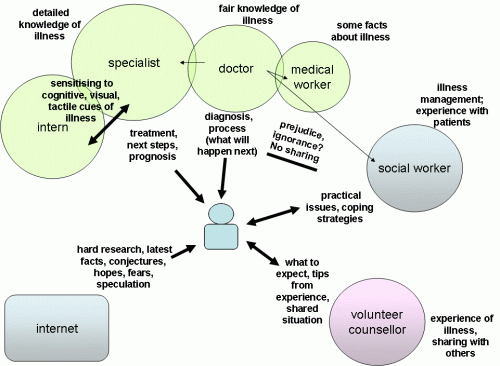
  • The above diagram offers interesting visualization for sharing knowledge, and is worth being considered for adapting in the Multifaith & Multicultural environments.


    Community Wise Resources:

  • Knowledge-Based Community Development A Path to Success
    What exactly is knowledge-based community development? ... Should you be thinking about going the way of knowledge-based community development? ...
  • Sharing Knowledge for Community Development and Transformation: A Handbook, by Dr. Kingo J. Mchombu. Originally published in October 2002 by Oxfam Canada, this 162-page handbook has been updated and is now in its second edition (2004). [Free publication] Contents include:
    Local Content: Internal Information and Knowledge Sources . . . . . .
    Indigenous Knowledge . . . . . . . . . . . . . . . . . . . . . . . .
    Traditional Objects and Items like Photos . . . . . . . . . . . . . . .
    Other Locally Created Information . . . . . . . . . . . . . . . . . .
    External Information and Knowledge Content

    See: previous item in this blog:
    Knowledge Management Applications in Multifaith & / or Multicultural Transactions
  • Thursday, June 01, 2006

    Multifaith Calendars - Visualize the Festivals, Feasts, Fasts, Festoons, etc

    Be Informed, Then Celebrate!
    Did you know that your employer has to accommodate your religious rights to celebrate whatever you wish to? Read:
    The Employer’s Duty to Provide Religious Accommodation. By P.A. Neena Gupta at Gowling Lafleur Henderson LLP for HRinfodesk - Canadian Payroll and Employment Law News, June 2004

    1. AMSSA - The Affiliation of Multicultural Societies and Service Agencies
    Through education and advocacy AMSSA seeks to create a just and equitable society for all Canadians, and The Multifaith Calendar plays an integral role in our efforts by providing a source of complete and accurate dates, times, and descriptions for over 140 religious and cultural occasions. [Calendar]

    2.BBC: - Religion & Ethics - Multifaith Calendar
    Holy days and festivals calendar
    All dates are shown using the Gregorian (Western) calendar. The calendar is accurate, but some dates may vary regionally because they are determined by the lunar calendar. Jewish festivals usually begin at sundown on the previous day. [Calendar]

    3. INTERFAITH CALENDAR: Primary sacred times for world religions
    The interfaith calendar is an open source provision of information. We believe in the peace making value of religious understanding and the importance of clear and accurate information. [Calendar]

    4. Beliefnet.com: Calendar of Holidays & Festivals, Religious holidays, observances, festivals, commemorations [Calendar]

    More Online Multifaith Calendars[source]
  • Red River College in Manitoba (PDF format for each month)
  • Religion & Ethics NewsWeekly (from WNET PBS broadcasting, N.Y.) – Weekly/monthly calendar with info from the Multi-Faith calendar above.
  • Steelworkers multifaith calendar
  • Bates College, Lewiston Maine, chaplain's office


  • Printed calendars:
  • "Mystics Wheel of the Year"

  • Additional Sources for calendars by Faith (general and specific) [source: Wikipedia, the free encyclopedia]:
  • Calendar
  • Islamic calendar
  • Hindu calendar
  • Zoroastrian calendar
  • Bahá'í calendar
  • Buddhist calendar
  • Note:
    A calendar date for any faith may require some additional sensitivity in relation to factors, such as, time and space. A few examples are given below:

  • The Hindu Calendar software, developed specifically for its Vaishnava denomination, states:
    Respected adiyens / maharajs / prabhus / matajis, please remember that the calendar of dates is only a dummy calendar and dates & breakfast times mentioned here are specifically for new Zealand in the given year may not be applicable for your longitude, latitude and time zone - check your local panjikas - which are free and available to download from the site below. The purpose of this database is to provide you will all information relevant to the events (festivals, feasts, fasts, etc). Trusting this finds you all well.
    (NOTE: the Luna based Tithis - phases of the Moon will be one day ahead for some places, ie., the USA - places West of Greenwich; while the Solar based Varams - days, will be ahead or behind depending on the Time Zone + or - from Greenwich, GMT )

  • For the information about Muslim or Islamic Calendar, see the web site: moonsighting.com.
    See also: A Brief Introduction To The Islamic (Hijri) Calendar
    For religious reasons, the beginning of a Hijri month is marked not by the start of a new moon, but by a physical (i.e., an actual human) sighting of the crescent moon at a given locale.
    The slight differences in printed Islamic calendars, worldwide, can therefore be traced to two primary factors: (1) the absence of a global criterion for first visibility; and (2) the use of different visibility criterion (or method of calculation). Weather conditions and differences in the observer's location also explain why there are sometimes differences in the observances of Islamic dates, worldwide [source]
    Further, "holidays such as Ramadan, Eid ul-Fitr, Eid ul-Adha, Ashura and Mawlud Nabi are dependent on the Islamic lunar calendar and vary from year to year." [Holidays & Attractions]

  • The Seventh-day Adventist Church states:
    Calculation of sunset and sunrise times are dependent on your exact latitude, and longitude coordinates. The continental maps do not provide accurate positioning. For more accurate results, manually enter latitude and longitude (Coordiantes south of equator, and west of Greenwich Meridian, must be negative), which can be obtained from Xerox PARC Map Server.


  • See news from other corners with similar interests:
  • Multi-Faith Calendar for May 2006: Students with Informed Faith Tolerance
  • For the next week, the multifaith calendar of multicultural London looks like this: details
  • The below calendar will be removed at the end of 2005 and replaced early in 2006 with an improved multifaith calendar." Details
  • want to wake up one day as a new multifaith calendar, leaving all bad thoughts, bad times and pains behind, but how can that be? details
  • The 2007 Multifaith Calendar produced by the Vancouver-based Multifaith Action Society will for the first time include the religion of Scientology amongst the world's faiths it celebrates. Details
  • As the internet continues to grow multifaith calendar web pages, we will strive to bring them to you. Details

    See also Google for Multifaith calendar OR calendars
  • Tuesday, May 23, 2006

    Knowledge Management Applications in Multifaith & / or Multicultural Transactions

    Since a couple of years I have been building a webliography on Knowledge Management: Society / Community Wise.
    This is a handy list of KM resources on social and humanities connection; it looks beyond corporate intellectual capital management space…; and tries to search for total-solutions that can be applied as best practices in everyday life.
    Today, I received a message in my other blog, by Joel C. Yuvienco, who brought attention to his excellent research article, viz., "Knowledge Management of Folk Knowledge: Harnessing the Power of Social Software Applications." Who Cites Joel

    I googled, to find if there are any Knowledge Management (KM) applications in the Web for Multifaith & / or Multicultural Transactions. I did not find any!!! May be I did not reach the deep Web.

    Whereas, I did find in Joel's article, some useful applications, with both generic and specific approaches. I am sure this article will be a harbinger and hopefully lead to focused KM applications for cultural, religious, and spiritual areas of human concern.

    However, googling for KM resources in Multifaith & / or Multicultural areas brought out some interesting citations (relatively speaking), including the following:
  • User profiling on the Web based on deep knowledge and sequential questioning, by Silvano Mussi, Expert Systems, Volume 23 Page 21 - February 2006 [fulltext, free content, courtesy: Blackwell Synergy]


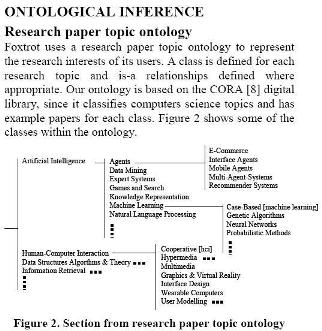
  • Capturing Interest Through Inference and Visualization: Ontological User Profiling in Recommender Systems, by Middleton, S. E., et al., In Proceedings of K-CAP2003, Sundial Beach Resort, Sanibel Island, Florida, USA. (2003) [fulltext, free content, courtesy Eprints]


    Tools for filtering the World Wide Web exist, but they are hampered by the difficulty of capturing user preferences in such a diverse and dynamic environment. Recommender systems help where explicit search queries are not available or are difficult to formulate, learning the type of thing users like over a period of time.
    We explore an ontological approach to user profiling in the context of a recommender system. Building on previous work involving ontological profile inference and the use of external ontologies to overcome the cold-start problem, we explore the idea of profile visualization to capture further knowledge about user interests. Our system, called Foxtrot, examines the problem of recommending on-line research papers to academic researchers. Both our ontological approach to user profiling and our visualization of user profiles are novel ideas to recommender systems. A year long experiment is conducted with over 200 staff and students at the University of Southampton. The effectiveness of visualizing profiles and eliciting profile feedback is measured, as is the overall effectiveness of the recommender system.

  • Indigenous Knowledge: Making it personal, by Racelle Kooy
    Extract: In my experience, Indigenous Knowledge and spirituality are one and the same, or at the very least enmeshed. I consider spirituality as the most sensitive area of IK. This is where the sacred and secret meet. The spiritual aspect of Indigenous Knowledge is literally about the beginning (cosmology) and the end (life after death)
  • tacit vs. explicit theories: the impact on our thinking and 'theorizing', Mentor's infosophy: socio-technological rendering of information details
  • BRICKS - Building resources for Integrated Cultural Knowledge Services
    The BRICKS Community is the aggregation of a large community of users, composed of content providers, art professionals, and art researchers, as well as students, citizens, tourists, etc. in order to build a consensus, sharing knowledge and service on Digital Content.
  • Come Xplore - Complore is a Social Research Collaboration Tool to connect the researchers in diverse fields around the world
  • Reporting Private and Public Religion, Joyce Smith, 2000
  • Multicultural Knowledge Management
  • Google: "Managing "indigenous Knowledge"

  • Looking in Google, for the above resources, was with the intention of getting the whole picture. KM Best practices on the whole, include, software, middleware and mindmaps, as well as, ontologies, taxonomies, etc. These perspectives will facilitate in bringing a holistic approaches in building both the necessary infrastructure and infostructure. My work, herein, is simply based on the professions' call to look, find and capture so that knowledge may be shared among all the concerned. Hopefully, we can attempt to reduce the digital divide in today's information society.

    What sort of taxonomy will help this type of KM?
    Consider the options:
    a) A few bloggers are busy around the globe with Intercultural Knowledge Management
    b) Tags that help in Jots - km


    A course for the information professionals at DRTC Banglore, in collaboration with Indo-German eGurukul on Digital Libraries

    KNOWLEDGE ORGANISATION AND RETRIEVAL
    1. Ontologies, Classification
    2. Controlled Vocabulary
    3. Indexing and Searching
    4. Semantic web technology

    A journal from a related field viz., Information for Social Change

    A new book has a chapter, Globalization, internationalization, and indigenization of pastoral care and counseling by Emmanuel Y. Lartey. See all the contents:
    A time of ferment and redefinition / Nancy J. Ramsay -- Pastoral theology as public theology : revolutions in the "fourth area" / Bonnie J. Miller-McLemore -- Power and difference in pastoral theology / Christie Cozad Neuger -- Globalization, internationalization, and indigenization of pastoral care and counseling / Emmanuel Y. Lartey -- Ferment and imagination in training in clinical ministry / Loren L. Townsend -- Methods in pastoral theology, care, and counseling / Joretta L. Marshall -- Contemporary pastoral theology : a wider vision for the practice of love / Nancy J. Ramsay. See the book details at Amazon

    Another book, published in 2005, is also relevant. Reclaiming Culture: Indigenous People and Self Representation, by Joy Hendry (Palgrave Macmillan). The contents of the book are: 1 Museums are transformed; Aboriginal tourism and that elusive authenticity; Indigenous or alter-native forms of cultural display; Language and formal cultural education; Arts, architecture, and native creativity; Land claims, archaeology, and new communities; International links, cultural exchange, and personal identity; Conclusions : what we can learn [Details: www.bn.com]

    P.S.Dear ALL: This is a friendly call to the KM gurus, guys and knowledge workers, and the Digital Natives: Just-in-case you know or have come across some reference, institution or research project in the above discussed area, please email it to me. I will cite you as the source of that information. I am sure that bloggers / blog-graphers at the KnowledgeBoard will get this message. Trusting to hear from you immediately. THANKS.

    Related Posts with Thumbnails

    PostRank


    Google
    Web multifaith.blogspot.com