
-
Playing with Religion in Digital Games (Digital Game Studies)
 Gregory P. Grieve
- Exploring Religious Community Online: We are One in the Network (Digital Formations)
Heidi Campbell
-
Digital Religion: Understanding Religious Practice in New Media Worlds Digital Religion
Heidi A. (EDT) Campbell
-
iGods: How Technology Shapes Our Spiritual and Social Lives
Craig Detweiler
-
Digital Religion, Social Media and Culture: Perspectives, Practices and Futures (Digital Formations)
Pauline Hope Cheong
-
The Digital Puritan - Vol.III, No.3
John Bunyan
-
Byte Religion
Christian Kirtchev
-
Cyber Meltdown: Bible Prophecy and the Imminent Threat of Cyberterrorism
Ron Rhodes
-
Cyber Religion: An entry from MACM's Contemporary American Religion
Brenda E. Brasher
-
13 Blasphemies: Cyber Attack on the Holy Bible
S.R. Smith
-
Religion and the Internet - current cult fundamentalist Cyber ??religion ( Internet Society) (1998) ISBN: 4000262742 [Japanese Import]
Tosa Masaki
-
Religion on the Internet (Religion and the Social Order) (Religion and the Social Order) (Vol 8)
Jeffrey K. Hadden
-
Cyber Evangelism
Esther Ogbonda
-
Cyber With Me God (First Edition)
Lee Vosloo
-
iMuslims: Rewiring the House of Islam (Islamic Civilization and Muslim Networks)
Gary R. Bunt
-
Digital Amen: A Look into the New Cyber Congregation
S. Antonio Moffett
-
CyberQuest: The Complete Virtual Adventure
Sigmund Brouwer
-
eMinistry - Virtual Pathways for Spiritual Leadership: Taking Evangelism into the Cyber Frontier
Rev. Dr. Lauren Speeth
-
Cyber Snoop Nation: The Adventures Of Littanie Webster, Sixteen-Year-Old Genius Private EyeOn Internet Radio
Anne Hart
-
Saved In Cyber-Space: How One Man Found Salvation On-line & How the Internet Can Bring Christ to the Entire Planet
Matthew Long
-
Japanese
Religions on the Internet: Innovation, Representation, and Authority
(Routledge Research in Religion, Media and Culture)
Erica Baffelli
-
The First Cyber Death Extravaganza!: A Mock Passion Play
Scott Douglas
-
Super
Cyber Box Scope and Sequence First Quarter: Cyber Wars, 7 Weeks of
Fighting to Win Over the Enemy, Satan 6 Weeks of Faith, Responsibility,
Self
Charisma Life Publishers

Loading...
|
Vox populi: "In building bridges across communites, this site supports the efforts of Beliefnet.com and religioustolerance.org." Says Seeker of Truth (Reviews & Testimonials) @ xomreviews.com
 The Blog Content Map is helpful organizing diverse material/content. Codakiz Browse By Label: Blog Content Map  Blogging Books Business--Religious aspects Diversity  You are here Cyber Worship Faith and the Media Golden Rule Holidays and holy days Inner-Net Interfaith Dialog Knowledge Management Libraries and Librarians Multicultural People Prayers Religious accommodation Seekers Spiritual Audit Symbols Theology Tolerance Web analytics Women |
Showing posts with label Books. Show all posts
Showing posts with label Books. Show all posts
Thursday, November 21, 2013
New on the Spiritual Web Shelves - A select list of books


Monday, October 28, 2013
Reading now: Fifty Popular Beliefs That People Think Are True
"Prometheus, the premiere publisher of skeptical literature, here issues a book that deserves to be shelved alongside the works of such giants of the field as [James] Randi, [Michael] Shermer, [Paul] Kurtz, and [Joe]Nickell. With a combination of lively prose and keen analytical reasoning, the author examines some of contemporary culture's most commonly held beliefs… A valuable, not to mention very entertainingly written, addition to the literature of skepticism." - Booklist starred review
On the same shelf:
Monday, August 12, 2013
`God' Word Usage Counted as Harvard, Google Scan Digital Books
The history of publishing industry in the Google age has a different turn. It is not anymore quantifying the frequency of titles/articles published by authors, subjects, countries, decades, and centuries--aka bibliometrics. It is now about the socio-psycho-liinguistics, semantics, usage, keyword frequency, etc.
The following is one sample of this emerging scenario:
The following is one sample of this emerging scenario:
- `God' Word Usage Counted as Harvard, Google Scan Digital Books Bloomberg
- Changes in language and word use reflect our shifting values, UCLA psychologist reports, Study analyzes more than 1 million books published over 200 years, By Anna Mikulak and UCLA Newsroom
- Language in books shows how we have grown more selfish, By Richard Gray, Telegraph
- Google Book Tool Tracks Cultural Change With Words : NPR
Friday, January 16, 2009
Saturday, January 26, 2008
Solomon had left the building by Jim Coyle
... All of which suggests the board should probably purchase The Complete Idiot's Guide to the Bible, which says that "most people admit that when it comes to knowing what's between those covers, their comprehension is, well, holey."
So, as a public service, we offer the following handy test.
A notorious tree in the Garden of Eden bore: a) pomegranates b) kiwis c) papaya d) forbidden fruit.The Tower of Babel was: a) the original Question Period b) the ancient world's tallest free-standing structure c) the birthplace of Don Cherry d) a multilingual construction project gone bad.
Christ cast the money-changers out of the: a) Wal-Mart b) casino c) payday loan outlet d) temple.Christ fed multitudes with: a) lox and bagels b) super-sized fries c) curry takeout d) loaves and fishes.
Which of the following do not belong: a) The Good Samaritan b) The Sermon on the Mount c) The Raising of Lazarus d) George Bush.
Who called the Bible the source of "practically every good title you ever heard"? a) ABBA b) Madonna c) Liberace d) Hemingway.
extract from: Solomon had left the building - Toronto Star Jan 24, 2008 Jim Coyle
Friday, August 24, 2007
Atheist, Naturalist, Secular humanist, Or None-of-the-above

PS. This is about the author, Mr. Christopher Hitchens. And, "Hitchens, one of our great political pugilists, delivers the best of the recent rash of atheist manifestos." Publishers Weekly, on his God Is Not Great: How Religion Poisons Everything.
"I loved it when Mr. Hitchens, prosemaster, stuck it to the smug Western cult of the Dalai Lama. But that was in 1998. Now, as Max Blumenthal reports, he’s reduced to following in the footsteps of Dalai Lama groupie Sam Harris with How Religion Poisons Everything, which I guess is supposed to be shocking. From the cover of his earlier book Letters To A Young Contrarian, the idea seems to be that he’s not afraid to be the cigarette-smoking guy in a detective coat, giving you a steely look and leveling with you about how it is. “Join me in the League of Contrarians, if you can handle the flames.” source: Behind the contrarian curve, @ John Gorenfeld’s blog
"As a self-declared and proud "antitheist" whose most recent book carries the subtitle "How Religion Poisons Everything," Hitchens has no reason to view human beings as different from animals in any essential way. It is a stance that can lead to things like Princeton ethicist Peter Singer's support for killing severely disabled babies and the unconscious elderly. As Professor Singer has explained: "The life of a newborn is of less value than the life of a pig, a dog or a chimpanzee." If antitheist Hitchens asserts some inherent human special-ness, he is not only insufferable but inconsistent." Source: Jewish World Review June 4, 2007 / 18 Sivan, 5766, Man or beast? By Rabbi Avi Shafran
Wednesday, August 01, 2007
The End of Harry Potter

What Civilization Does Harry Potter Create?
By Orson Scott Card
Spoiler alert: This post reveals the ending of Book Seven.
So we’ve lived in J.K. Rowling’s moral universe for a decade now, seven volumes worth. Where did she take us, and to the degree that we have been reshaped (or reaffirmed) by that moral universe, what has she made of us?
What hath Harry Potter wrought?
Read this @ Beliefnet: Blogalogue - Debates About Faith
See also:
Friday, June 15, 2007
Ethnic Conflict and Civic Life: Hindus and Muslims in India:
By Ashutosh Varshney
From the Publisher
"What kinds of civic ties between different ethnic communities can contain, or even prevent, ethnic violence? This book draws on new research on Hindu-Muslim conflict in India to address this important question. Ashutosh Varshney examines three pairs of Indian cities—one city in each pair with a history of communal violence, the other with a history of relative communal harmony—to discern why violence between Hindus and Muslims occurs in some situations but not others. His findings will be of strong interest to scholars, politicians, and policymakers of South Asia, but the implications of his study have theoretical and practical relevance for a broad range of multiethnic societies in other areas of the world as well. The book focuses on the networks of civic engagement that bring Hindu and Muslim urban communities together. Strong associational forms of civic engagement, such as integrated business organizations, trade unions, political parties, and professional associations, are able to control outbreaks of ethnic violence, Varshney shows. Vigorous and communally integrated associational life can serve as an agent of peace by restraining those, including powerful politicians, who would polarize Hindus and Muslims along communal lines."
 Contents: Preface. I. Arguments and theories : 1. Introduction. 2. Why civil society? Ethnic conflict and the existing traditions of inquiry. II. The national level : 3. Competing national imaginations. 4. Hindu-Muslim riots, 1950-1995: the national picture. III. Local variations: Aligarh and Calicut: internal and external cleavages : 5. Aligarh and Calicut: civic life and its political foundations. 6. Vicious and virtuous circles. Hyderabad and Lucknow: elite integration versus mass integration: 7. Princely resistance to civil society. 8. Hindu nationalists as bridge builders? Ahmedabad and Surat: how civic institutions decline: 9. Gandhi and civil society. 10. Decline of a civic order and communal violence. 11. Endogeneity? Of causes and consequences. IV. Conclusions : 12. Ethnic conflict, the state, and civil society. Appendices : A. Questionnaire for the project on Hindu-Muslim relations in India. B. Data entry protocol for the riot database. C. Regression results: Hindu-Muslim riots, 1950-1995. Notes. Index. [source: https://www.vedamsbooks.com]
From The Critics
Alfred Stepan
Varshney’s rich findings about what types of civil society organizations and activities help contain religious conflict – and which do not – open up a whole new agenda for theorists and activists alike.
David Laitin
Varshney has taken us a long way in understanding intra-Indian variations in communal violence,and he leaves a set of unanswered questions for future research. What more can be asked from a work of social science?
James C. Scott
A landmark synthesis. Varshney’s comparison of communal violence and tranquillity in urban India is lucid,theoretically self-conscious,original,and empirically convincing. It should launch a veritable flotilla of comparable studies of civil life in its admirable wake.
Susanne Hoeber Rudolph
South Asia scholars and social scientists will have to read Varshney,they will cite him,and they will learn from him.
Samuel P. Huntington
Ethnic Conflict and Civic Life is an outstanding work of social science,one of the most important studies of ethnic violence to appear in many years. This book will decisively shape future scholarly research on this subject and deserves to have an important impact on public policy concerning ethnic conflict. [source: www.bn.com]
The Punchline:
"This is a remarkably good book. The empirical research is impeccable; the analysis is careful; and the argument is persuasive. The issue is simple: Why is it that certain towns in India erupt into communal violence and others do not?" says kashif @ Indian Muslims and The Muslim World
"This is a must read book for leaders in civic socities, it is an eye opener for Muslims as well as Hindus.
I had interviewed Ashutosh about 3 years ago on Radio,he is a brilliant speaker and knows his research like the back of his hand."
I urge you to read the book. Mike Ghouse @ Indian Muslims
From the Publisher
"What kinds of civic ties between different ethnic communities can contain, or even prevent, ethnic violence? This book draws on new research on Hindu-Muslim conflict in India to address this important question. Ashutosh Varshney examines three pairs of Indian cities—one city in each pair with a history of communal violence, the other with a history of relative communal harmony—to discern why violence between Hindus and Muslims occurs in some situations but not others. His findings will be of strong interest to scholars, politicians, and policymakers of South Asia, but the implications of his study have theoretical and practical relevance for a broad range of multiethnic societies in other areas of the world as well. The book focuses on the networks of civic engagement that bring Hindu and Muslim urban communities together. Strong associational forms of civic engagement, such as integrated business organizations, trade unions, political parties, and professional associations, are able to control outbreaks of ethnic violence, Varshney shows. Vigorous and communally integrated associational life can serve as an agent of peace by restraining those, including powerful politicians, who would polarize Hindus and Muslims along communal lines."
Contents: Preface. I. Arguments and theories : 1. Introduction. 2. Why civil society? Ethnic conflict and the existing traditions of inquiry. II. The national level : 3. Competing national imaginations. 4. Hindu-Muslim riots, 1950-1995: the national picture. III. Local variations: Aligarh and Calicut: internal and external cleavages : 5. Aligarh and Calicut: civic life and its political foundations. 6. Vicious and virtuous circles. Hyderabad and Lucknow: elite integration versus mass integration: 7. Princely resistance to civil society. 8. Hindu nationalists as bridge builders? Ahmedabad and Surat: how civic institutions decline: 9. Gandhi and civil society. 10. Decline of a civic order and communal violence. 11. Endogeneity? Of causes and consequences. IV. Conclusions : 12. Ethnic conflict, the state, and civil society. Appendices : A. Questionnaire for the project on Hindu-Muslim relations in India. B. Data entry protocol for the riot database. C. Regression results: Hindu-Muslim riots, 1950-1995. Notes. Index. [source: https://www.vedamsbooks.com]From The Critics
Varshney’s rich findings about what types of civil society organizations and activities help contain religious conflict – and which do not – open up a whole new agenda for theorists and activists alike.
Varshney has taken us a long way in understanding intra-Indian variations in communal violence,and he leaves a set of unanswered questions for future research. What more can be asked from a work of social science?
A landmark synthesis. Varshney’s comparison of communal violence and tranquillity in urban India is lucid,theoretically self-conscious,original,and empirically convincing. It should launch a veritable flotilla of comparable studies of civil life in its admirable wake.
South Asia scholars and social scientists will have to read Varshney,they will cite him,and they will learn from him.
Ethnic Conflict and Civic Life is an outstanding work of social science,one of the most important studies of ethnic violence to appear in many years. This book will decisively shape future scholarly research on this subject and deserves to have an important impact on public policy concerning ethnic conflict. [source: www.bn.com]
The Punchline:
"This is a remarkably good book. The empirical research is impeccable; the analysis is careful; and the argument is persuasive. The issue is simple: Why is it that certain towns in India erupt into communal violence and others do not?" says kashif @ Indian Muslims and The Muslim World
"This is a must read book for leaders in civic socities, it is an eye opener for Muslims as well as Hindus.
I had interviewed Ashutosh about 3 years ago on Radio,he is a brilliant speaker and knows his research like the back of his hand."
I urge you to read the book. Mike Ghouse @ Indian Muslims
Tuesday, June 05, 2007
"Amateur" charge infuriates blogosphere
By Eric Auchard, Jun 5, 2007 9:06AM EDT,
BERKELEY, California (Reuters) - Internet culture, often portrayed as the vanguard of progress, is actually a jungle peopled by intellectual yahoos and digital thieves, according to a Silicon Valley entrepreneur-turned-dissenter.
Andrew Keen, a 47-year-old Briton who founded dot-com era music startup Audiocafe, argues that basic notions of expertise are under assault amid a cultural shift in favor of the amateurism of blogs, MySpace and other popularity-driven sites.
"Millions and millions of exuberant monkeys ... are creating an endless digital forest of mediocrity," Keen writes in a book published Tuesday. continue reading
see also what other bloggers are saying about this book: The Cult of the Amateur: How Today's Internet is Killing our Culture
see also:
Book review: "The Cult of the Amateur: How Today's Internet Is Killing Our Culture"
By MICHIKO KAKUTANI, New York Times July 8, 2007
Saturday, April 07, 2007
Cyber Worship in Multifaith Perspectives' Book Discussion on OMNI TV
Cyber Worship in Multifaith Perspectives
I will be discussing my book on April 10, 11 and 14, 2006 @ the timings mentioned below. You are invited to watch this show with family and friends.
Rogers Cable: Voices of Religion: (Channel 10 or 63):
Tuesday April 10 @ 3 - 3:30am
Wednesday April 11 @ 10 - 10:30am
Saturday April 14 @ 8:30 - 9am
Wednesday, April 04, 2007
Thought for the day by Rabbi Balfour Brickner

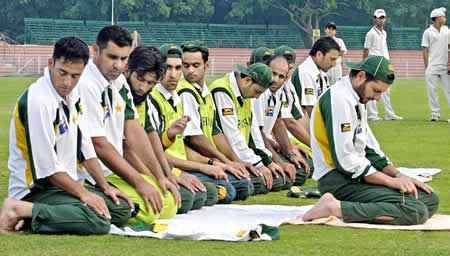

PUNCHLINE: Above pitures are in the news depicting prayers for 'success of the Cricket Team member (s)'
"We have all attended athletic game at which a member of the clergy or even a layperson led the assembled fans in a prayer for their community's team to win the game. Should God be expected to confer to each side its desired response of victory? Or should we be praying in a different way, or perhaps not at all? It seems to me that the only legitimate prayer that might be uttered before a game is not for victory, but for health and safety of the players, especially since the possibility of physical harm and injury is inherent in the very nature of the game. I never heard any one lead a stadium full of fans in such a prayer. Nor am I aware that fans or relative of players have ever requested such prayer. Yet, ironically I suspect that if a player were seriously injured, his parents and friends would pray fiercely for his recovery."(Rabbi Balfour Brickner, in Finding God in the Garden: Backyard Reflections on Life, Love, and Compost 2002 p. 57)
Related posts from my blog:
Sunday, April 01, 2007
Getting passion out of your profession

It is much-ado-about how to keep loving your living...come what may....
By COLLEEN CLARKE, 24 Hours Toronto [Winning in the Workplace], March 28, 2007 p. 18
"Do you remember how you reacted the first time you got "the call" telling you, you "got the job?" Whether it was your first job or the one you have now, waiting for that phone call was misery. When it came, you whooped and hollered and went out to celebrate.
Five years later, you are out drinking - not in celebration, but from lack of enthusiasm. What happened?
Nina Spencer, author and conference speaker of Nina Spencer and Associates in Toronto, shows us how to keep loving your living in her book, "Getting Passion Out of Your Profession."
Follow Nina's eight steps to empower yourself to grab your professional life and give it a fling.
1. Practice positive thinking. Listen to yourself, become conscious of all the negatives you communicate, "Is this a bad time?" Yikes, try, "Did I get you at a good time?" Never suggest a negative. "I can't do that until ..." becomes "I will be able to do this ... when ..." Positive talk and action begets positive outcomes.
2. Project personal self worth ...
3. Protect your sense of humour...
4. Play with perspective...
5. Profess purpose...
6. Preserve energy and enthusiasm....
7. Promise to persevere...
8. Perpetuate relationships. ..."
continue reading in 24 Hours Toronto
See also Nina Spencer's What comes first...the chicken or the egg...the job or the passion?
Wednesday, March 28, 2007
Book Reveiw # 4 - Cyber Worship in Multifaith Perspectives
This is most recent review of my book: Cyber Worship in Multifaith Perspectives. Previous reviews [published in Sept 2006, Scarecrow Press]
 NB. American Reference Books Annual (ARBA) is Free this week (April 15 - 22, 2007, to celebrate the national library week), read my review online for free:
Publisher: Scarecrow, Lanham, MD (2006)
Price: $45.00pa
ISBN/ISSN: 0-8108-5257-8
Content Area: RELIGIONS
Handbooks and Yearbooks; General Works; Religion; Philosophy and Religion
John W. Storey - Professor of History, Lamar Univ., Beaumont, Tex
ARBA 2007
Cyber worship in Multifaith perspective - part1
Cyber worship in Multifaith perspective - part2
Cyber worship in Multifaith perspective - part3
Cyber worship in Multifaith perspective - part4
"Visit the Sistine Chapel, attend the Church of Satan, have a question (dial a priest)... would be a useful addition to high school and university reference collections. " ARBA (American Reference Books Annual), vol. 38 (2007)
NB. American Reference Books Annual (ARBA) is Free this week (April 15 - 22, 2007, to celebrate the national library week), read my review online for free: Publisher: Scarecrow, Lanham, MD (2006)
Price: $45.00pa
ISBN/ISSN: 0-8108-5257-8
Content Area: RELIGIONS
Handbooks and Yearbooks; General Works; Religion; Philosophy and Religion
John W. Storey - Professor of History, Lamar Univ., Beaumont, Tex
ARBA 2007
Several scholars have noted the zest with which American Pentecostals in the twentieth century have taken to the airwaves via radio, television, and satellite to proclaim an "old fashioned gospel," as if there were something anomalous about using cutting-edge means of communication to advance an "old" point of view. In fact, however, religious leaders and institutions have always embraced the latest marvels of modern technology to spread their message. Consequently, it should come as no surprise that religion has found the Internet, and the resulting opportunities for cyber worship are practically unlimited. This study by Mohamed Taher, educated in Indian universities and currently an information specialist at the Ontario Multifaith Council on Spiritual and Religious Care in Toronto, Canada, provides the most comprehensive "map" to religion on the Internet.This is not a guide to "everything one needs to know" about various religious expressions. Instead, it shows how religion functions on the Internet and points toward the remarkable array of religious practices available at one's fingertips. From mainline religions, whether Christian, Jewish, Islamic, Hindu, or Buddhist, to "alternative traditions," such as new age movements, paganism, cults, nonconformists, or nonmainstream spiritualities, Taher has cataloged them all. Visit the Sistine Chapel, attend the Church of Satan, have a question (dial a priest)-it is all possible through cyber worship. Without leaving one's living room an individual can have a simulated religious experience from around the globe. Circumnavigation is made earlier with this study, which would be a useful addition to high school and university reference collections.
Friday, March 23, 2007
Two New Books in Multifaith Perspectives
I came across two new books today, with common threads that explain the emergence of faiths and belief systems (in physical and virtual, respectively), focusing on theories (sociological, anthropological), forces (philosophical, theological) and most importantly, my favorite, i.e., taxonomies.
A word about what makes these distinct:
* reviewed in:

About the author:
My related books and publications:
My related book reviews:
My related blog posts:
Wednesday, February 14, 2007
Thought for the day by John Selby
"A primary teaching throughout the Koran, repeated over and over by the faithful in ritual prayer, is the fact that "God wants to give you clarity and guide you, and to be present for you ... for God is most knowing, most wise ... God wants to lighten your burden, knowing the humanity was created weak." (p. 127)
...In the Islamic tradition, God already knows what is in our hearts, and we don't have to tell Allah what help we need. All we need to do is call on God, by whatever name, surrender our ego center to our spiritual center, and shift from broadcast to receive mode. As I understand it, this is what Muslims are doing at a spiritual level five times a day when they pause for ritual prayer." (Chpater 5: Emotional healing, Mohammed; p. 127)
Quoted from: meditation secrets from the world's greatest teachers, by John Selby. (2003) Contents: Succeeding with meditation - Breath watch, Patanjali - Quieting the mind, Lao-Tzu - Accepting the truth, Buddha - Heart awakening, Jesus - Emotional healing, Mohammed - Self-remembering, Gurdjieff - Experiencing bliss, Krishnamurti - Your daily meditation program.
Author: Psychologist John Selby has spent over thirty years practicing and teaching meditation and its benefits and has studied meditative techniques and traditions all over the world. The author of seven meditation and self-help books, Selby has sold more than half-a-million copies of his books worldwide. His books have been translated into eight languages.
From The Critics: "While some adherents may not be comfortable with the yoking together of these often disparate traditions, Selby knows his audience, and his work will find a receptive readership among those interested in New Age spirituality." [Library Journal @ Bn.com]
Monday, September 11, 2006
Cyber Worship in Multifaith Perspectives
My new book is released now:
Cyber Worship in Multifaith Perspectives, Lenham, MD. Scarecrow Press, 2006. ISBN: 0810852578
Click here: WorldCat
Cyber Worship in Multifaith Perspectives, as is implied by its name, explores worship (i.e., Prayer, Praise, Scripture, Sacrament, Rituals, Confessions, Eucharist, Rites, Pilgrimages, Reflection, Contemplation, etc.) on the Internet. It is not an "everything you need to know" guide about the subjects of faith and belief, religions-online, religions on the Net, or religions in cyberspace. Rather, it is a book about religious and spiritual experience under the rubric, cyber worship, which is the variety of ways religious devotion is performed and carried out on the Internet. The term 'Cyber Worship' is a catchall phrase, which includes variants such as online worship, virtual worship, electronic prayer, cyber puja, cyber synagogue, and so on. Dr. Mohamed Taher has thus assembled a quick reference for two groups: those communities that are involved in Cyber Worship and business Webs that collaborate in sustaining wired environments. As such, this book provides an interesting and current perspective on a practice that will continue to grow in the future.
The book has a number of research-based articles (full text, see chapter four), taxonomies, business resources, and more importantly, Web metrics and web analytics (see Appendices). A detailed list of contents (and cataloging info) is at Library of Congress
Contents (in brief)
1. Cyber Worship/Meditation Webwise: Noah, Abraham and Beyond
2. Cyber Worship as-is On the Web
3. Fast Track to Multifaith Resources for Cyber Worship: What's Hot
4. Navigating the Deep Sacred Space via Experiences of the Wise
5. Glossary: A Pathfinder for Future History
What Scholars Are Saying:
"Mohamed Taher's new book provides an indispensable guide for considering the resources of worship online, whatever the faith, wherever believers are located."—Bruce Lawrence, Duke University
"Cyber Worship in Multifaith Perspectives is an important and significant contribution to the new field of scholarship examining the religious dimension of the Internet. By employing Webmetrics, Dr. Taher presents readers with the most comprehensive and up-to-date mapping of the religious websites available, providing essential information for those wishing to better understand how religion functions and flourishes on the WWW and also those interested in using this new medium for their own spiritual quest."—Christopher Helland, Dalhousie University
my previous publications
My previous posts in this area:
Wednesday, July 26, 2006
Multifaith Stacks: Reading Between the Shelves
People are fond of reading between the lines. And, librarians are not just fond of shelf reading, rather religiously adhere to this as a best practice. A question is how often librarians get an opportunity to read between the shelf reading process? I have no clue. Do you know if any librarians read between the shelves?
The bottome line: In the words of William Faulkner, “Read, read, read.”
Got the new ALA catalog in the mail yesterday, and my 3-year-old son was going through each page yelling: "READ! READ! READ! READ! READ!" through each spread of READ posters. His take: "This is a FUNNY magazine. Why does it say READ so much?" continue reading
I think it is a reminder from to stay current with best practices.
I found one interesting book (thanks to Prof. A Neelameghan):
Reaching Out to Religious Youth: A Guide to Services, Programs, and Collections (Libraries Unlimited Professional Guides for Young Adult Librarians Series) by L. Kay Carman (Editor), Libraries Unlimited (2004) ISBN: 0313320411; Table of Contents @ bn.com
Book Description
Do religious teens in your community think your library has "nothing for me"? Shouldn't your library be actively embracing all of the diverse populations in your community? For many the teen years are times of intense spiritual and religious growth. Public libraries, charged with serving all facets of their communities, must reach out to all people, including religious youth. If that prospect seems daunting, this book can help. It provides you with a vision and a plan for enhancing your library service to religious teens with pertinent information that helps you understand the different belief systems and traditions of various religious groups and practical guidance for developing services and collections to serve their needs. Chapters cover the major religious groups in the United States today: Protestant, Evangelical, Catholic, Latter-day Saints, Orthodox Christianity, Seventh-day Adventist, Jewish, Muslim, Buddhist, and Hindu. In each chapter, a snapshot summary introduces you to the basic aspects of the religion, such as origins, beliefs, and practices. A discussion of the history and core beliefs and values follows. After describing common misconceptions and stereotypes, the authors detail the formative experiences of teens in these groups, and discuss what types of services they need in the library. Advice on building your collection is accompanied by helpful booklists; and ideas for services and programs supplement the resource. Lists of pertinent publishers and helpful Web sites make this an invaluable guide.
About the Author:
L. KAY CARMAN is Youth Services Librarian at Hillsboro Public Library, Oregon. She also serves the Church of Jesus Christ and Latter-day Saints as a Stake Relief Society Education Counselor.
Reviews:
From School Library Journal
This resource belongs in the office of all librarians who want to understand the religious backgrounds of their patrons and thus serve them better. Many librarians have at least a basic understanding of Christianity and Judaism but lack knowledge of some of the other major religious followings, and thus aren't sure where to obtain appropriate materials. continue reading:
see also:
by Gregory A. Smith (Editor), Donald G. Davis (Foreword by). McFarland & Company, 2002. Table of contents
Friday, June 23, 2006
Multifaith Stacks: A New Book for the Information Professionals
Print, online and handouts abound that deal with sacred presence in secular environment, or vice-versa. And the list includes themes such as, God at the reference desk, religious questions at the reference desk, a liturgy for the faithful Librarian, a faith-based Website: Stack C: The Sacred and the Secular, etc. I myself have been contributing, in humble ways at: The Multifaith Information Gateway, with focus on diversity in the workplace, religious accommodation in the public sphere, Knowledge management for religious and spiritual domains, etc. Nevertheless, these bits and bytes are scattered (or dispersed using Bradford's lingo) in the deep end of the Web. Let me admit my own ignorance: there is not one book on the concept of evidenced-based sacred-cum-secular librarianship.*** But, there is some light at the end of the tunnel.
I just read information about a new book. I think it inspires the communities of best practices, or those who are involved in information handling, in today's Multifaith, Multicultural, Multilingual, Multiracial and Pluralistic age. A sample from all-of-the-above areas is summarized in the following book:
Sacred Stacks: The Higher Purpose of Libraries and Librarianship, BY NANCY KALIKOW MAXWELL (American Library Association, 2006).
FROM THE PUBLISHER
Drawing from history, sociology, and philosophy, Sacred Stacks voices the importance of the library profession and libraries as community institutions in a secular time. Though secular institutions, libraries can be the setting for a spiritual vacation.
I am simply lost, and let you yourself see the subject heading for this book in LC are:
Whereas, other cataloguers do not feel comfortable with this concept of minimal level cataloging. Ranganathan's faceted scheme would be handy, if one is looking. In addition, my cataloging inspiration is from Sanford (aka Sandy) Berman, another master of content visualization. And using his approach which he called alternative cataloging, I think, we need at least five more headings. While Sandy would go an extra mile, if there is none in the LCSH, incidentally, in our case LC does have all the five. A search for any item dealing with sacred-cum-secular in the Multifaith Library's catalog will get you these and much more. More around Sandy's inspired content in available from my visual catalog Webliography
P.S. Thanks to Anna for information about this book. I wish to share her comment about the book:
on the same shelf:
------
*** Because of this total dearth of anthologies, I took up a book writing project. My new book, due for release this year is about Cyber Worship in Multifaith Perspective. See secular librarianship, Atheist Librarian Communist Librarian THEOLOGICAL LIBRARIANSHIP
I just read information about a new book. I think it inspires the communities of best practices, or those who are involved in information handling, in today's Multifaith, Multicultural, Multilingual, Multiracial and Pluralistic age. A sample from all-of-the-above areas is summarized in the following book:
Sacred Stacks: The Higher Purpose of Libraries and Librarianship, BY NANCY KALIKOW MAXWELL (American Library Association, 2006).
FROM THE PUBLISHER
Drawing from history, sociology, and philosophy, Sacred Stacks voices the importance of the library profession and libraries as community institutions in a secular time. Though secular institutions, libraries can be the setting for a spiritual vacation.
TABLE OF CONTENTS
1 Libraries as sacred, secular institutions 1
2 Librarians perform sacred functions 20
3 Librarians and libraries organize chaos 38
4 Librarians and libraries bestow immortality 48
5 Librarians and libraries uplift individuals and society 61
6 Libraries provide sacred, secular space 77
7 Librarians and libraries promote community 94
8 Librarians and libraries transmit culture to future generations 113
9 Implications of libraries as sacred, secular institutions 125
I am simply lost, and let you yourself see the subject heading for this book in LC are:
Libraries -- Aims and objectives.
Libraries and society.
Library science -- Philosophy.
Whereas, other cataloguers do not feel comfortable with this concept of minimal level cataloging. Ranganathan's faceted scheme would be handy, if one is looking. In addition, my cataloging inspiration is from Sanford (aka Sandy) Berman, another master of content visualization. And using his approach which he called alternative cataloging, I think, we need at least five more headings. While Sandy would go an extra mile, if there is none in the LCSH, incidentally, in our case LC does have all the five. A search for any item dealing with sacred-cum-secular in the Multifaith Library's catalog will get you these and much more. More around Sandy's inspired content in available from my visual catalog Webliography
P.S. Thanks to Anna for information about this book. I wish to share her comment about the book:
While I do not agree with everything in this book, I did find this brief nine chapter, 156 page book a balm for my soul and my book spines.
on the same shelf:
- An Invisible Wall: The Relationship Between Congregational and Seminary Libraries in the United States by Rebecca Klemme Eliceiri Journal of the American Theological Library Association
------
*** Because of this total dearth of anthologies, I took up a book writing project. My new book, due for release this year is about Cyber Worship in Multifaith Perspective. See secular librarianship, Atheist Librarian Communist Librarian THEOLOGICAL LIBRARIANSHIP
Subscribe to:
Posts (Atom)


